Download
1 / 12
120 likes | 259 Vues
This guide outlines the essential criteria for classifying an object as a mineral, including its natural occurrence, solid state, definite chemical composition, crystal structure, and inorganic nature. It details the three major types of minerals: silicates (the most abundant), carbonates, and iron oxides/sulfides. Additionally, various properties used for mineral identification are described, such as color, luster, crystal shape, hardness (via Mohs Scale), streak, cleavage and fracture, specific gravity, and special properties like magnetism and radioactivity.

E N D
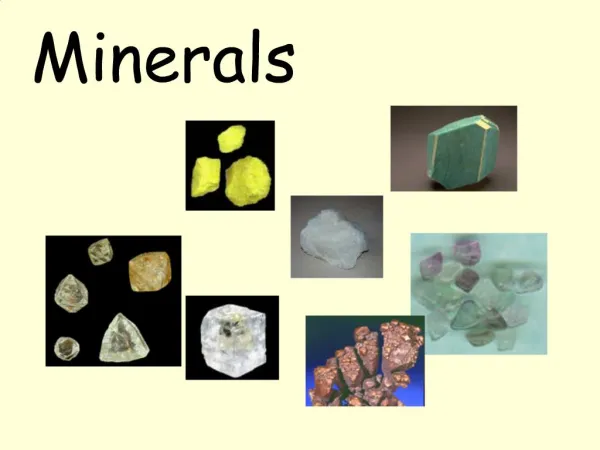
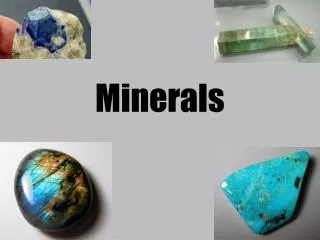
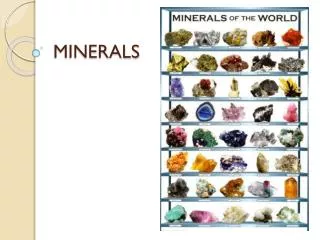
Minerals Geology: Slides 11-21
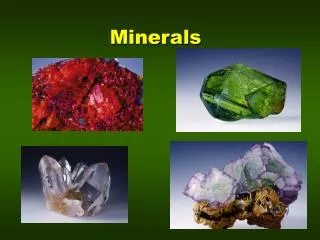
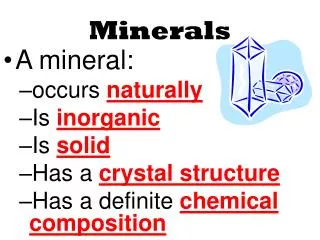
Minerals • For an object to be considered a mineral it must meet the following criteria: • It must be naturally occurring • It must be a solid • It must have a definite chemical composition • It must have a definite crystal structure • It must be inorganic (contains nothing that was ever living)
Mineral Types • 1.) Silicates • 90% of all minerals belong to this group • Silicon + a metal (Al, Fe, etc.) • Atoms for a silica tetrahedron • The silica tetrahedron causes the minerals to have their distinct crystal shapes. • Feldspars – most common type of silicate found in the Earth’s crust (Al has replaced some of the Si in the tetrahedron)
Mineral Types • 2.)Carbonates • CO3 bonded to a metal (common around here) • Generally react to acids (creating rocks that are easily dissolved by acid rain making caves and sink holes)
Mineral Types • 3.) Iron Oxides and Iron Sulfides • Iron combined with oxygen and sulfur • Very heavy, dense minerals • Resemble a piece of metal
Identifying Minerals • Minerals are identified using the following properties: (Some properties will be useful for some minerals and useless for others.)
Identifying Minerals • 1.) Color – least useful identification property • 2.) Luster – The way a mineral reflects light (vitreous [glassy], pearly, metallic, non-metallic [earthy]) • 3.) Crystal Shape – atoms forming distinct crystal patterns
Identifying Minerals • 4.) Hardness • The resistance of a mineral to being scratched • Uses the Mohs Hardness Scale • Mohs Scale ranks minerals from 1 – 10 (1 is softest and 10 is the hardest) • Talc = 1 and Diamond = 10 (not always whole numbers)
Identifying Minerals • 5.) Streak • The color of a mineral’s powder • To obtain the mineral’s powder you rub the mineral across a Streak Plate (porcelain) • Mineral color and the mineral streak are not necessarily the same. (All minerals do not have a streak – some are too hard)
Identifying Minerals • 6.) Cleavage and Fracture • The way in which a mineral breaks or splits • Cleavage = smooth break on a flat surface • Fracture = rough break with jagged edges
Identifying Minerals • 7.) Specific Gravity • Ratio of the mass of a mineral compared to the mass of an equal volume of water
8.) Special Properties Taste Odor Sound Radioactivity Fluorescence Double refraction Reacts with acid Magnetic Identifying Minerals