
SlideServe
Menu
Préférences
© SlideServe · v2026

Project Cycle Management

lovet avatar
19 diapositives · 1.3K Views · Jan 05, 2020

Project Cycle Management. Basic PCM Training Course. Learning Objectives - 1. By the end of the course, participants will better understand: What defines a “project”, and its role relative to other forms of aid; the “project cycle”, key documents and stakeholder responsibilities;
Project Cycle Management - slide 1
01 / 19Project Cycle Management
1 / 17

Télécharger la présentation

Project Cycle Management
Une image / un lien ci-dessous est fourni (tel quel) pour télécharger la présentation

Politique de téléchargement : le contenu du site vous est fourni TEL QUEL pour votre information et votre usage personnel ; il ne peut être vendu, concédé sous licence ni partagé sur d’autres sites sans l’accord de son auteur.Le contenu vous est fourni TEL QUEL, pour votre information et votre usage personnel uniquement. Téléchargez la présentation en cliquant sur ce lien. Lors du téléchargement, si vous ne parvenez pas à télécharger une présentation, l’éditeur a peut-être supprimé le fichier de son serveur.Pendant le téléchargement, si vous ne parvenez pas à obtenir une présentation, le fichier a peut-être été supprimé par l’éditeur.

F I N

Plus de contenu associé

Transcription de la présentation
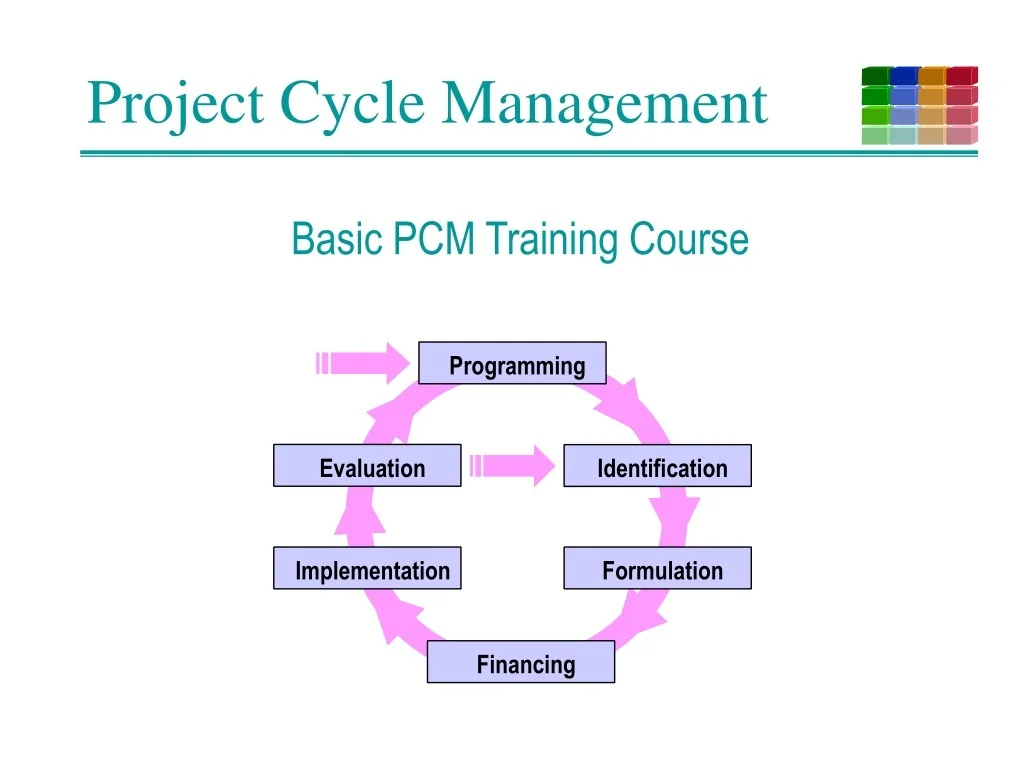
  1. Project Cycle Management Basic PCM Training Course

  2. Learning Objectives - 1 • By the end of the course, participants will better understand: • What defines a “project”, and its role relative to other forms of aid; • the “project cycle”, key documents and stakeholder responsibilities; • the link between Project Cycle Management (PCM) and the Logical Framework Approach (LFA); • the principles of the Logical Framework Approach and how the main analytical tools can be applied

  3. Learning Objectives - 2 • the process of preparing a Logical Framework Matrix, and the key information it should contain; • the principles of monitoring and evaluation, and the importance of identifying appropriate indicators and sources of verification; • how to link activity schedules and budgets to the Logical Framework Matrix, in support of operational planning; • how to use PCM/LFA principles to develop appropriate questions for inclusion in Terms of Reference.

  4. Training Approach The training will: The training approach will not: • Build on participant experience and interests • Explain key PCM principles and analytical tools • Provide opportunities to learn through practical exercises and team tasks • Assume the trainer has all the answers • Explain the detail of different EC management procedures & administrative requirements • Focus on lectures and extensive reading

  5. First Part • The project • and • Principles of project cycle management

  6. Why Projects • ?

  7. The Situation we face

  8. What is a project? • A project should always … • Be consistent with, and supportive of, broader policy and programme objectives, but • Create/develop something ‘new’, rather than simply support ongoing activities And have … • clearly defined objectives which address identified needs • a clearly identified target group(s) • clearly defined management responsibilities • a start and finish date • a specified set of resources and budget

  9. Examples of Projects • Examples of projects include: • ·    Developing a new product or service. • ·     Effecting a change in structure, staffing, or style of an organisation. • ·     Designing a new transportation vehicle. • ·     Constructing a building. • ·     Running a campaign for political office. • ·     Implementing a new business procedure or process.

  10. Policy, Programme, Project • EC projects should form part of, and be consistent with: • National development policies (including Poverty Reduction Strategies); • EC country strategy papers; • Sector programmes (e.g in health, education, criminal justice); and/or • Priorities of non-state actors National & sector policies EC country strategy Non state actors Govt. programmes Project Project Projects

  11. Why Projects Can Fail • not linked to broader programme or policy framework • set rigid targets and processes (inflexible) • set optimistic goals to attract finance - false expectations • can encourage authoritarian style of interaction • end abruptly and usually too short term • ‘driven’ by aid professionals and not locally owned • induce insecure state of ‘project culture’ • force relationships to be contractual • do not encourage experiential learning - through trial and error

  12. The Project Cycle

  13. Experiences Unclear strategic framework Supply driven projects Poor analysis of situation Activity-orientated planning Non-verifiable results Short-term vision Lessons learnt not considered Imprecise project documents PCM Sectoral/programme linkage Demand driven approach Improved analysis Objective orientated planing Verifiable results Focus on sustainability Learning from evaluation Standardised formats Objectives of PCM

  14. PCM Principles • Project cycle phases - structured & informed decision-making, and feedback from evaluation • Partner / stakeholder ownership - involvement of stakeholders in decision-making, including emphasis on teamwork and communication • Logframe planning - comprehensive & consistent analysis • Integrated documentation - standardised documentation and assessment criteria • Can be applied to both projects and programmes

  15. The Project Cycle:Main Documents & Responsibilities EC Programming Documents National Programming Documents Decision which option to study further after stakeholder consultation Pre-feasibility studies Evaluation reports based on relevance, efficiency, effectiveness, impact and sustainability Decision about using the results in future projects Feasibility study Formulation of the project Progress and monitoring reports Draft financing proposal Decision to continue or to reorient the project Financial Proposal Decision to Fund the programme Decision to extend the project Financing Agreement

  16. EU and Romanian Programming documents • EU programming documents: • Accession Partnership • Roadmaps for Romania and Bulgaria • Romanian programming documents: • National Plan for Romania’s Accession to EU • Plan of Priority Measures for the Accession into EU • National Development Plan 2002-2006 • Action Plan for the Strengthening of the Administrative Capacity and of the Judiciary System • Joint Programming Document • ISPA Financing Strategy • National Programme for Agriculture and Rural Development • Sector Strategies • Position Papers

  17. Elements consistent with PCM/LFA • Coherence with programming documents (policy/country strategy) • Assessment of sector policy and lessons learned • Initial stakeholder analysis • Initial problem analysis • Objectives and strategy analysis • Outline of options for implementation and workplan/calendar for the formulation phase

  18. EC Role in Project Management The EC does not carry out projects, it supports institutions in partner countries to carry out their projects : Local ownership is critical to project success

  19. Importance of Team Work • The success of project cycle management depends on effective team-work between stakeholders: • Projects are about “Change Management” • Respecting different knowledge, skills and roles • Establishing responsibilities of different team members • Giving adequate time to the process, while still focusing on results • Communicating clearly