The Cognitive Model
Analyzing cognitive biases in individuals with eating disorders, examining effectiveness of altering thought processes as treatment, and exploring causality and victim blaming issues in the cognitive model.

The Cognitive Model
E N D
Presentation Transcript
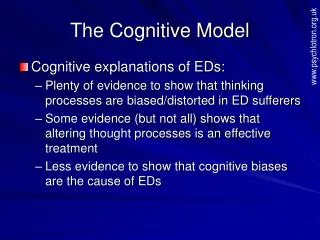
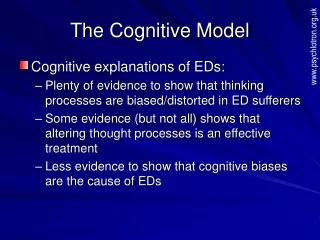
The Cognitive Model www.psychlotron.org.uk • Cognitive explanations of EDs: • Plenty of evidence to show that thinking processes are biased/distorted in ED sufferers • Some evidence (but not all) shows that altering thought processes is an effective treatment • Less evidence to show that cognitive biases are the cause of EDs
The Cognitive Model www.psychlotron.org.uk • Issues for evaluation: • Evidence • Direction of causality • Blaming the victim
The Cognitive Model www.psychlotron.org.uk • Evidence • Plenty of research shows that people with psychological disorders have faulty or irrational thinking processes • However…
The Cognitive Model www.psychlotron.org.uk • Not much evidence for the view that faulty thinking precedes other psychological symptoms (cause or effect?) • People who are clinically normal also think irrationally – so what’s the difference? • All the cognitive model does is state the obvious e.g. depressed people think gloomy thoughts. No! Really?
The Cognitive Model www.psychlotron.org.uk • Ethical issues: • By locating psychological problems in faulty thinking processes, the cognitive model sometimes blames the victim • E.g. a person might be depressed because their situation is genuinely dreadful – but the cognitive model implies that the problem is their perceptions