Understanding Primary, Secondary, and Tertiary Industries in Economic Systems
This overview explores the essential aspects of primary, secondary, and tertiary industries that form the backbone of a nation’s economy. Primary industries focus on natural resources like agriculture, fishing, and mining. Secondary industries transform these raw materials into usable products through manufacturing and construction. Tertiary industries provide services such as utilities, transportation, and finance, which are crucial for economic stability. Together, these industries drive growth and define the wealth of nations in various economic systems such as capitalism and socialism.


Understanding Primary, Secondary, and Tertiary Industries in Economic Systems
E N D
Presentation Transcript
Industry Man’s “Hard Work” to Make a Living
Primary Industries • Natural resource: useful substances found in earth • Agriculture • Farming • Cash crop: some income for family • Animal husbandry • Fishing • Seafood is the world’s 2nd largest commodity • Forestry
Primary Industries • Mining • Minerals: solid crystals that occur naturally • Metals • Precious metals (gold, silver, platinum) • Common metals (copper, lead, iron, aluminum) • Alloys: combination of metals (steel: strongest, most common) • Nonmetal minerals (limestone, sulfur, uranium) • Fossil fuels (coal, petroleum (oil), natural gas)
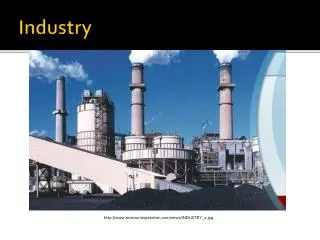
Secondary Industries • Taking raw materials and changing them into useful form • Raw materials: natural resources that have been extracted by primary industries • Construction • Manufacturing • Nondurable (food, chemicals, paper) • Durable (homes, furniture, cars, machinery
Secondary Industries • Changes in manufacturing • Industrial Revolution: rise of machines, steam engine • “Second” Revolution: electricity; telephone, telegraphs • Technology: application of science to industry • Information: computers, internet, smart phones
Tertiary Industries • Produce services (intangible products) • Infrastructure • Utilities (electricity, gas, water, trash, sewage disposal) • Transportation (water, land, air) • Communication (print media, electronic media) • Trade • Market: people or businesses buy products • Exports: primary and secondary goods that a country ships to other countries • Imports: goods a country receives from other countries • Tariffs: taxes on exports and imports • Embargo: ban on exports or imports to certain countries
Tertiary Industries • Finance • General or support services • Government
The Wealth of Nations • Economics: study of choices • Wealth: the ability to produce new things • Economic systems (essay) • Capitalism • Capital: money and equipment necessary to build industries • Free market: businesses compete freely in the marketplace for buyers with little interference from the government • Socialism • Command economy: government determines which industries are developed, what they produce, and where they development • Communism: most extreme form of socialism
Culture • Society: the relationships among human beings (86) • Culture: Society’s total way of life (86) • Humanism: humans can solve their own problems (88) • Language • Over 6600 languages in the world (89) • Dialect: speech patterns in a given language (89) • Literacy: the ability to read or write a language (91) • Soccer is the world’s most widely played sport (100)
Family, Religion, and the State • Nuclear family: husband, wife, and children (91-92) • Extended family: nuclear + grandparents, uncles, aunts, and cousins (92) • Five major religious groups: Christianity, Eastern, Islamic, Tribal, and Jewish (94-95, map) • Nation: large group of people with common language, history, sense of identity (94) • Nation-state: nation who has established its own government (state) (94) • Empire: nation conquering other nations beyond its borders (94)
History & Demography • Three major divisions of history: Ancient, Medieval, Modern (96-97) • Age of Imperialism: age of empire building (98) • Enlightenment: government comes from “the will of the people” (98) • Cultural convergence: growing similarities in cultures (99) • Demography: the study of human populations and their characteristics (101) • Census: official government count of population (101) • Life expectancy: number of years a person expected to live (102) • Urbanization: growth of urban areas at the expense of rural areas (104)
Government • Duty of government is to protect the people from violence (108) • Know these terms (108-109) • Absolute monarch • Dictatorship • Totalitarian government • Democracy • Constitutional monarchy • Republic
Government con’t • Diplomacy: the art of negotiation (110) • Treaty: formal agreement between nations (110) • Know these two international organizations and their functions (111) • NATO • United Nations (UN)