Download

1 / 0
Reduction of Monosaccharides
20 likes | 544 Vues
REACTIONS OF MONOSACCHARIDES. Reduction of Monosaccharides. The reduction of the carbonyl group produces sugar alcohols, or alditols. D-Glucose is reduced to D-glucitol also called sorbitol . Oxidation of Monosaccharides.

Télécharger la présentation 
Reduction of Monosaccharides
An Image/Link below is provided (as is) to download presentation
Download Policy: Content on the Website is provided to you AS IS for your information and personal use and may not be sold / licensed / shared on other websites without getting consent from its author.
Content is provided to you AS IS for your information and personal use only.
Download presentation by click this link.
While downloading, if for some reason you are not able to download a presentation, the publisher may have deleted the file from their server.
During download, if you can't get a presentation, the file might be deleted by the publisher.
E N D
Presentation Transcript
- REACTIONS OF MONOSACCHARIDES Reduction of Monosaccharides The reduction of the carbonyl group produces sugar alcohols, or alditols. D-Glucose is reduced to D-glucitol also called sorbitol.
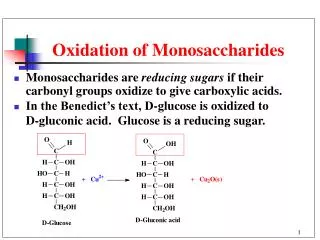
- Oxidation of Monosaccharides Monosaccharides are reducing sugars if their carbonyl groups oxidize to give carboxylic acids. Benedict’s reagent (CuSO4) can oxidize aldehydes with adjacent hydroxyl groups The blue Cu2+ ions in the Benedict’s reagent are reduced to form a brick-red precipitate, Cu2O In the Benedict’s test, D-glucose is oxidized to D-gluconicacid. Glucose is a reducing sugar.
- O HO = aldonic acid COOH C gluconic a. O O H H = = COOH CH2OH C C CH2OH COOH aldaric acid monosaccharide glucaric a. D-glucose alduronic acid glucuronic a. Oxidation of Monosaccharides
- Disaccharides
- A disaccharide is formed when a hydroxyl group on one monosaccharide reacts with the anomeric carbon (C-1) of another monosaccharide to form a glycosidic bond Links may be α or β 1-4’ link: The anomeric carbon is bonded to oxygen on C4 of second sugar. 1-2’ link: The anomeric carbons of the two sugars are bonded through an oxygen. The free anomeric carbon is called reducing end According to the position of the linkage between the sugar units, disaccharides are classified into non-reducing such as sucrose and reducing such as maltose and lactose. Disaccharides
- Disaccharides Formed from two monosaccharides Joined by a glycosidic bond A condensation reaction: glucose + glucose maltose glucose + galactose lactose glucose + fructose sucrose
- C C C C O O C C C C C C C C Condensation reaction OH OH
- C C C C O O C C C C C C C C Condensation reaction OH OH
- C C C C O O C C C C C C C C Condensation reaction O H2O
- C C C C O O C C C C C C C C Condensation reaction 1 4 O A disaccharide 1,4 glycosidic bond
- & Isomerism OH OH
- and Anomers for D-Glucose The new –OH on C1 is drawn down for the anomer, and up for the anomer. -D-Glucose -D-Glucose
- FRUCTOSE standard position cis = b up = D 1 .. : anomeric carbon 2 6 3 5 2 .. 4 3 4 1 .. 5 6 b-D-(-)-Fructofuranose D-(-)-Fructose
- Cyclic Structure of Fructose As a ketohexose, fructose forms a cyclic structure when the —OH on C-5 reacts with the C=O on C-2. -D-Fructose -D-Fructose
- Maltose A disaccharide in which two -D-glucose molecules are joined by an -1,4-glycosidic bond. Malt Sugar
- - D-Maltose -1,4-glycosidic bond
- Lactose Composed of -galactoseand -glucose linked by a -1,4-glycosidic bond. Milk Sugar
- α-D-Lactose -1,4-glycosidic bond
- Sucrose Composed of glucose and fructose molecules joined by ,-1,2-glycosidic bond. Has no isomers because mutarotationis blocked. Table Sugar
- Sucrose α, -1,2-glycosidic bond
- Disaccharide Synthesis Energy +
- Disaccharide Hydrolysis Disaccharide hydrolyzed to its corresponding of monosaccharides. Maltose + H2O Glucose + Glucose Lactose + H2O Glucose + Galactose Sucrose + H2O Glucose + Fructose

More Related