SlideServe
Menu
Préférences
© SlideServe · v2026

Embracing True Agility: Rethinking Our Assumptions in Software Development

lucian-woodward avatar
40 diapositives · 542 Views · Nov 06, 2014

In the quest for true agility, a critical reassessment of our beliefs about software development is necessary. This discourse, led by Damon Poole, CTO of AccuRev, challenges the traditional notion of development as "tried and true" and examines the effectiveness of mainstream practices in modern contexts. By focusing on real-time feedback, customer value, and continuous improvement, organizations can uncover better ways to work. Join the conversation on how to mitigate mental barriers and align your entire organization with agile principles to drive substantial value creation and process enhancement.
Embracing True Agility: Rethinking Our Assumptions in Software Development - slide 1
01 / 40Embracing True Agility: Rethinking Our Assumptions in Software Development
1 / 17

Télécharger la présentation

Embracing True Agility: Rethinking Our Assumptions in Software Development
Une image / un lien ci-dessous est fourni (tel quel) pour télécharger la présentation

Politique de téléchargement : le contenu du site vous est fourni TEL QUEL pour votre information et votre usage personnel ; il ne peut être vendu, concédé sous licence ni partagé sur d’autres sites sans l’accord de son auteur.Le contenu vous est fourni TEL QUEL, pour votre information et votre usage personnel uniquement. Téléchargez la présentation en cliquant sur ce lien. Lors du téléchargement, si vous ne parvenez pas à télécharger une présentation, l’éditeur a peut-être supprimé le fichier de son serveur.Pendant le téléchargement, si vous ne parvenez pas à obtenir une présentation, le fichier a peut-être été supprimé par l’éditeur.

F I N

Plus de contenu associé

Transcription de la présentation
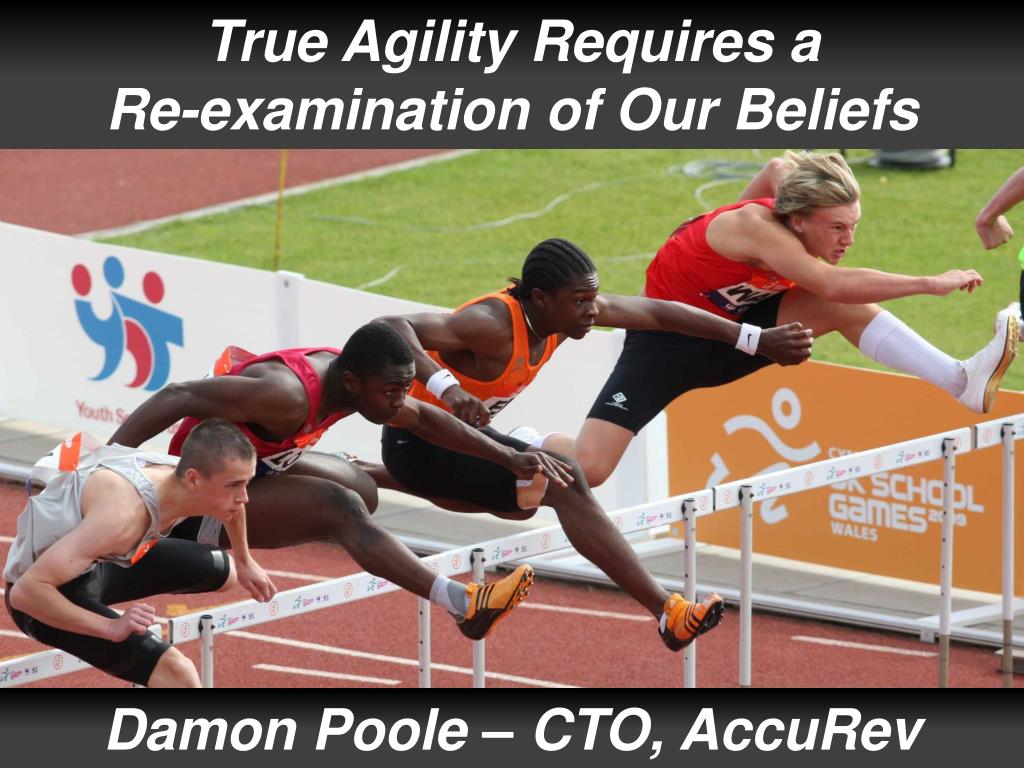
  1. True Agility Requires aRe-examination of Our Beliefs Damon Poole – CTO, AccuRev

  2. Mental Barriers

  3. “Value for individuals?” “Value for organizations?”

  4. “Traditional Development is tried and true”

  5. The Success of Waterfall Software Development

  6. The Alternative to Software

  7. Is Traditional Development Really “Tried and True?” • Poll: How long does it take to learn “the process” when you start a new job? • What are the mainstream practices? • How well does it scale? • Consider the following examples of mainstream adoption that scales • Java • C# • HTML

  8. “Agile is easy”

  9. Removing Impediments is the Heavy Lifting 7 6 5 4 Months 3 2 1 1 week Impediments

  10. “We’re already Agile!”

  11. True Agility Requires Learning and Experience

  12. Phrases From the Agile Manifesto “uncovering better ways” “become more effective” “Responding to change” “satisfy the customer” “competitive advantage” “Deliver working software frequently” “valuable software”

  13. Realtime Feedback Burn Down Build & Test Results Velocity 40 30 Story Points 20 Backlog 10 Iteration Burnup Taskboard 0 40 1 3 5 7 9 11 13 15 17 19 30 Time Story Points 20 10 0 10/4 10/2 10/9 10/11 10/11 10/15 10/17 10/19 10/23 10/25 Time

  14. Realtime Feedback All Information is shared by the team

  15. Iteration Review What did we accomplish? How was it received?

  16. Retrospective – Looking in the Mirror How can we do better?

  17. Value and Feedback UserStories Product Owner Continuous Integration CI Short Iterations $$$ $

  18. True Agility • Focus on customer value • Constant improvement • Significant improvement in work life • Significant improvement in organization viability • Whole organization aligned around all of the above

  19. “Agile only effects the development teams”

  20. Agile Scope Upper Management Agile program management and PPM Middle Management Line Management Agile project management (Scrum) Lean Agile technical practices (XP) Individual Contributors Agile

  21. “Individuals are the problem”

  22. “People can’t be trusted / aren’t self-motivated”

  23. Traditional Development

  24. Traditional Development ? ? ? ? ? ? ? ?

  25. Traditional Development ? ? ? ? ? ? ? ? ? ? ? ?

  26. Traditional Development What is this??

  27. “The value of work is the work itself”

  28. Company Todo $$$ Results

  29. Market/Customers Product Mgmt Strategy Cancelled Shelved Unused Results old You Todo new Customer Value $$$ Tangible Value Revenue Bank Account People Knowledge

  30. “Decreasing costs works, improvement efforts don’t”

  31. Agile Development Limited WIP Cross Functional Master Backlog Continuous Integration Int Colo Teams Task board User Stories One Piece Flow Daily Standups Int Scrum Master Unit Tests Int Frequent Demos Product owner Retrospectives Refactoring

  32. Agile Development Int Hooray! Int Int

  33. Top Ten Agile Blindspots “We’re already Agile” “Agile is easy, we’ve done all that before” “There’s no real benefit for individuals” “There’s no real benefit for organizations” “Traditional development is tried and true” “The value of work is the work itself” “Agile only affects the development teams” “Reducing costs works, improvement efforts don’t” “Individuals are the cause of the problems” “People can’t be trusted/aren’t self-motivated”

  34. Conclusion • True Agility is a tremendous value creation and process improvement engine • Agile allows you to uncover and address blindspots as part of that engine

  35. Resources/Q&A • Damon Poole (dpoole@accurev.com)http://damonpoole.blogspot.com • Extreme Programming Explained2nd Edition, Kent Beck • Agile Software Development with ScrumKen Schwaber & Mike Beedle • Lean Software Development, Mary Poppendieck and Tom Poppendieck DIY Agile