Strengthening TB Services and Community Involvement: Key Progress and Future Directions
The progress since the Mekong Conference highlights a high-level uptake of PITC and ICF, albeit with varied success and low IPT and IC rates. While collaboration between national programs is improving, multi-sectoral involvement is crucial. Community participation, especially from PLHA and marginalized groups, shows great promise. Key issues include stigma, the need for improved monitoring, and integrating TB services in broader health responses. Urgent communication improvements and investment in operational research are necessary to sustain progress and enhance TB service delivery.

Strengthening TB Services and Community Involvement: Key Progress and Future Directions
E N D
Presentation Transcript
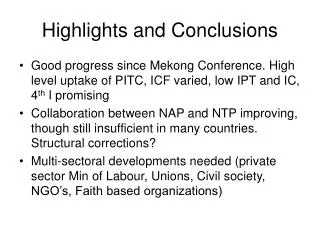
Highlights and Conclusions • Good progress since Mekong Conference. High level uptake of PITC, ICF varied, low IPT and IC, 4th I promising • Collaboration between NAP and NTP improving, though still insufficient in many countries. Structural corrections? • Multi-sectoral developments needed (private sector Min of Labour, Unions, Civil society, NGO’s, Faith based organizations)
Conclusions 2 • Communities involvement and participation: great potential PLHA, rights based approach, TB heavy medical • Encouraging examples of extension of TB services among MARPS (Harm reduction services for IDU). Issues of stigma (triple when TB in HIV/IDU) • Need to strengthen monitoring functions better and more reliable data needed by programmes, to sustain advocacy and document achievements
Conclusions 3 • Engage/include TB services into linked responses (HIV/STI/RSH services) • Concerns about women’s vulnerability and social exclusion. Include TB services for HIV+ mothers through PMTCT • Slow progress of IC efforts. Risk of fragmentation, but opportunity to integrate IC into HSS and submit proposals for funding
Conclusions last • Urgent need to improve communication, especially in support of ICF (TB Diagnostic algorithm), and IPT (addressing decision makers, professional bodies-experts, and beneficiaries • Investment on operational research, in developing better tools for ICF (diagnostic algorithm) and IPT (cost effectiveness and benefit analysis) • Momentum for funding, especially for TB