3.1 Laplace’s Equation
990 likes | 3.07k Vues
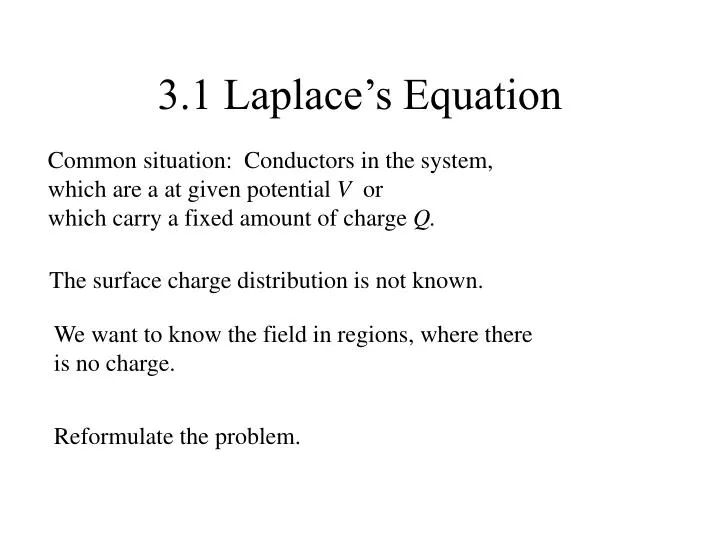
3.1 Laplace’s Equation. Common situation: Conductors in the system, which are a at given potential V or which carry a fixed amount of charge Q. The surface charge distribution is not known. We want to know the field in regions, where there is no charge. Reformulate the problem.


3.1 Laplace’s Equation
E N D
Presentation Transcript
3.1 Laplace’s Equation Common situation: Conductors in the system, which are a at given potential V or which carry a fixed amount of charge Q. The surface charge distribution is not known. We want to know the field in regions, where there is no charge. Reformulate the problem.
+ Boundary conditions. (e.g. over a surface V=const.) Important in various branches of physics: gravitation, magnetism, heat transportation, soap bubbles (surface tension) … fluid dynamics
One dimension Boundary conditions:
Two Dimensions Partial differential equation. To determine the solution you must fix V on the boundary – boundary condition. V has no local minima or maxima inside the boundary. Rubber membrane Soap film A ball will roll to the boundary and out.
Three Dimensions Partial differential equation. To determine the solution you must fix V on the boundary, which is a surface, – boundary condition. V has no local minima or maxima inside the boundary. Earnshaw’s Theorem: A charged particle cannot be held in a stable equilibrium by electrostatic forces alone.
First Uniqueness Theorem The solution to Laplace’s equation in some volume V is uniquely determined if V is specified on the boundary surface S. • The potential in a volume V is uniquely determined if • the charge density in the region, and • the values of the potential on all boundaries are specified.
Second Uniqueness Theorem In a volume surrounded by conductors and containing a specified charge density, the electrical field is uniquely determined if the charge on each conductor is given.
Image Charges What is V above the plane? Boundary conditions: There is only one solution.
Image charge The region z<0 does not matter. There, V=0.
Induced surface charge: Force exerted by the image charge Force on q: Different from W of 2 charges!! Energy:
Example 3.2 Find the potential outside the conducting grounded sphere.