

venetian skul
E N D
Presentation Transcript
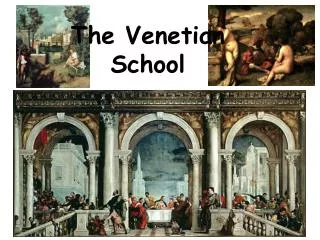
The Venetian School
The Venetian School Color as the dominant element in the pictorial design. Stress laid upon worldly joys in contrast to idealism of the Florentines.
Jacopo Bellini • He was considered the Father of Venetian Painting. • He painted monumental and historical frescoes of serene and majestic character.
Jacopo Bellini Madonna of the Cherubim c.1450. Wood. Academia, Venice, Italy Jacopo Bellini St. John the Evangelist (left); The Apostle Peter (right) Two Panels from an Alterpiece. Tempera on wood Gemäldegalerie, Berlin, Germany
Jacopo Bellini The Virgin and Child Adored by Lionello d'Este Wood. Louvre, Paris, France Jacopo Bellini St. John the Baptist Preaching Louvre, Paris, France
Jacopo Bellini Presentation of the Virgin at the Temple Louvre, Paris, France
Giovanni Bellini • Son of Jacopo • He used the scheme of continuing the carved frame into the painted architecture of the niche on which the seated virgin is placed on a pedestal. • Subordinated interests in the form of the nude to the beauty and the sensual appeal of the flesh.
Giovanni Bellini Virgin and Child Enthroned with Saints Francis, John the Baptist, Job, Dominic, Sebastian, and Louis of Toulouse 15ft 4in X 8ft 4in 1478
Giovanni Bellini San Zaccaria Altarpiece 16’5” x 7’9” oil on wood 1505
Giovanni Bellini. Pietà. c. 1455-60. Wood panel, 52x42 cm. Academia Carrara, Bergamo, Italy Giovanni Bellini. Crucifixion c. 1455-60. Tempera on panel. 54.5x30 cm. Civico Museo Correr, Venice, Italy
Giovanni Bellini. The Presentation in the Temple. c. 1460. Tempera on wood. 80x105 cm. Cverini-Stampagla Gallery, Venice, Italy Giovanni Bellini. Transfiguration. c. 1460. Tempera on wood. 134 x68 cm. Civico Museo Correr, Venice, Italy
Giovanni Bellini. Christ Blessing. c. 1460. Tempera on wood. 58x46 cm. Louvre, Paris, France Giovanni Bellini Greek Madonna. c. 1450-55. Tempera on panel. 82x62 cm. Pinacoteca di Brera, Milan, Italy.
Giorgione • Was taught by Giovanni Bellini, was the first to paint frankly carnal pictures. • He was a genius in the use of colors and had the capacity to express the inner most thoughts of his models.
Giorgione The Tempest Oil on canvas 13” x 28 ¾ “ 1510
Giorgione Sleeping Venus,1510 Oil on canvas 3’6” x 5’9”
Giorgione Sleeping Venus,1510 Oil on canvas 3’6” x 5’9”
Titian (Tiziano Vecelli) • Was also taught by Giovanni Bellini, was considered the greatest painter of the Venetian School. • He inherited Giorgione’s magical use of color and changes from the lyrical to the more dramatic style.
Titian Venus of Urbino,1538 Oil on canvas 3’11” x 5’5”
Giorgione (and/ orTitian?) Pastoral Symphony (Concert), 1508 Oil on canvas, 43” x 54”
Tiziano Vecelli (Titian). Sacred and Profane Love 1514: Galleria Borghese, Rome
Titian Flora 1515
Self-Portrait 1562: Staatliche Museen Berlin
Tiziano Vecelli (Titian). Rape of Europa 1562: Isabella Stewart Gardner Museum, Boston Tiziano Vecelli (Titian). Portrait of Pope Paul III Cathedral Museum, Toledo
Tiziano Vecellio “Titian” Entombment 1488-1576
Titian Pesaro Madonna 1519-26 Oil on canvas 15’11” x 8’10”
Tintoretto (Jacopo Robusti) • Painted one of the largest painting in the world which contained over four hundred figures. • He was the pupil of Titian and was called “II Furioso” because of his speed in painting which results in carelessness. Self-Portrait 1588: Musee du Louvre, Paris
Tintoretto The Last Supper, 1592-94 Oil on canvas 12’ x 18’8”
Tintoretto. The Stealing of the Dead Body of St. Mark 1566 Gallerie dell’Accademia Venice
Tintoretto. Adoration of the Magi 1582: Scuola di San Rocco, Venice
Tintoretto. St. Nicholas Kunsthistorisches Museum Vienna
Tintoretto. The Miracle of St. Mark 1548: Gallerie dell’Accademia, Venice Tintoretto. The Origin of the Milky Way 1570: National Gallery, London
Paolo Veronese • He painted enormous canvasses of great decorative richness, usually very spectacular pictures with imposing architectural backgrounds, giving the illusion of great space.
Veronese Feast in the House of Levi, 1573 Oil on canvas 18’3” x 42’
Veronese The Triumph of Venice oil on canvas ceiling of the Doge’s Palace, Venice 1585
El Greco (Domenicos Theotocopulus) Ressurection 1597-1604 • He painted austere religious subjects inspired by Jesuit fanaticism. • His works are characterized by elongated figures with grave expressions producing mystical and melancholic effects accentuated by the use of light to gain an effect of flame like movement.
El Greco Burial of Count Orgaz Oil, 4.60 x 3.60 m 1586
El Greco Purification of the Temple, Oil on Canvas (43”x 50”) , 1541-1614