New Route to Fabricating PDMS-based Microfluidic Components
10 likes | 132 Vues
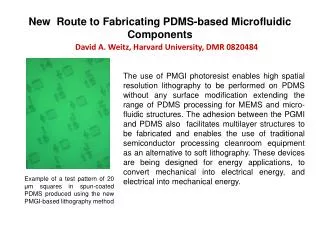
This study presents a novel method for fabricating PDMS-based microfluidic components utilizing PMGI photoresist, allowing for high spatial resolution lithography without requiring surface modifications. The strong adhesion between PMGI and PDMS enables the creation of multilayer structures, facilitating the use of conventional semiconductor processing cleanroom equipment as an alternative to traditional soft lithography techniques. These microfluidic devices are designed for energy applications, focusing on converting mechanical energy to electrical energy and vice versa. An exemplar test pattern of 20 μm squares in spun-coated PDMS demonstrates the efficacy of the PMGI-based lithography approach.


New Route to Fabricating PDMS-based Microfluidic Components
E N D
Presentation Transcript
New Route to Fabricating PDMS-based Microfluidic Components David A. Weitz, Harvard University, DMR 0820484 The use of PMGI photoresist enables high spatial resolutionlithography to be performed on PDMS without any surface modification extending the range of PDMS processing for MEMS and micro-fluidic structures. The adhesion between the PGMI and PDMS also facilitates multilayer structures to be fabricated and enables the use of traditional semiconductor processing cleanroom equipment as an alternative to soft lithography. These devices are being designed for energy applications, to convert mechanical into electrical energy, and electrical into mechanical energy. Example of a test pattern of 20 μm squares in spun-coated PDMS produced using the new PMGI-based lithography method