Understanding Solutions and Colligative Properties: Key Concepts and Calculations
300 likes | 413 Vues
This document covers essential concepts related to solutions and colligative properties, including the definitions of solute and solvent, concentration calculations such as mass percent, parts per million, mole fraction, molarity, and molality. It also explains solution dilution, conversions between units, and provides examples to calculate molarity and molality in various scenarios. Additionally, the document highlights colligative properties like boiling point elevation and freezing point depression, detailing their formulas and significance for both electrolytes and non-electrolytes.


Understanding Solutions and Colligative Properties: Key Concepts and Calculations
E N D
Presentation Transcript
Chap13 - Solutions and Colligative Properties A solution is a solute (A) dissolved into a solvent (B).
Solute A Solvent B
A. Concentration • 1. Mass Percent = mass component x 100 total mass solution = grams A x 100 grams A + grams B
2. Parts per million (ppm) = mass component x 106 total mass solution ppt = x 103 ( ) ppb = x 109 ( ) Parts per thousand Parts per billion
3. Mole fraction (X) = mole component total moles XA = mole A mole A + mole B
4. Molarity (M) = moles of solute Liters of solution M = mole A L solution *Remember* 1L = 1000mL Look at Problem #1 = 0.0200 M
5. Molality (m) = moles solute kg solvent m = mole A kg B *Remember* 1g = 1mL for H2O 1000g = 1 kg Look at Problem #4 = 0.164 m
Dilution of Solution • M1V1 = M2V2 Answer to Worksheet 3a – 50 mL diluted 3b – 1.28 mL diluted
Conversion between Units • For H2O only, Molarity = molality. • Why? Because the density of H2O is equal to 1.00 g/mL. • Therefore, 1000mL = 1000g 1 L = 1 kg
Conversion between Units For any other solution other than an aqueous solution - YOU MUST USE THE DENSITY!!!!! Use the density to convert mass to volume.
Conversion between Units m = mole/kg mass solvent + add molar mass mass solute moles solute mass solution M = mole/L density volume solution
Conversion between Units m = mole/kg 1000 g = 1 kg mass solvent + add molar mass mass solute moles solute mass solution M = mole/L density volume solution 1000 mL = 1 L
Conversion between Units 1000 g = 1 kg + add molar mass density 1000 mL = 1 L
Your homework/classwork is worksheet –concentration conversions
Convert mass % to ….. • 5% HC2H3O2 5 g x 1mol/60g = 0.0833 mol • 95% H2O 95 g x 1mol/18g = 5.28 mol
Mole fraction • X = 0.0833mol / (0.0833 mol + 5.28 mol) • m = 0.0833 mol / 0.095 kg molality convert 95 g
Convert M to m • 1.13 mol to mol L solution kg solvent • 1000 mL x 1.05 g/ml = 1050 g solution • 1.13 mole KOH x 56.1 g/mol = 63.4 g solute density
1050 g solution – 63.4 g KOH 986.6 g solvent • m = 1.13 mol KOH = 1.15 mol 0.9866 kg kg
What about mass percent? 63.4 g KOH 1050 g solution
Dimensional Analysis • What is the molarity of concentrated HCl? • 39.0% HCl by mass and 1.13 g/mL density
Solution Calculations • What is the molarity of a 1.11 ppm solution of Zn2+ ions?
Solid Calculations • Chemical analysis showed 1.23 mg Fe in a 15.67 g sample of soil. • What is the Fe concentration in ppm?
Unusual concentration units • How many nano moles of Cu are present in 12.3 µL of 25 ppm CuSO4?
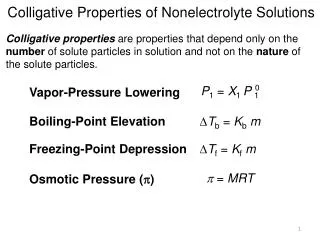
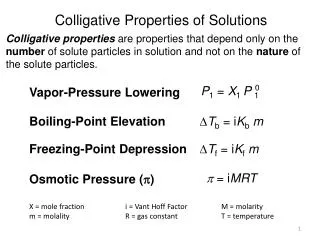
B. Colligative Properties • 1. Boiling Point Elevation ΔTb = kb • m • i for an aqueous solution Tb = 100oC+ (0.52 oC/m) •(m) * note that as molality increases ΔTb increases as well Kbfor water Normal B.P.
B. Colligative Properties • 2. Freezing Point Depression ΔTf = kf • m • i for an aqueous solution Tf = 0oC- (1.86 oC/m) •(m) * note that as molality increases ΔTf increases as well Kf for water Normal F.P.
Ex. Non-electrolyte (i=1) • Antifreeze is made at 25% C2H6O2 by mass. What is the Tb and the Tf? • Make your life easy and assume 1000g. • Why? Because molality is based upon kg of solvent • Mass percent 250 g C2H6O2 750 g H2O
molality Boiling and Freezing Point C2H6O2 H2O
Ex. Molecular Weight of Unknown • What is the MM of a sample if 250grams of the sample is placed into 1000grams of water and the temperature rose by 3.5°C?
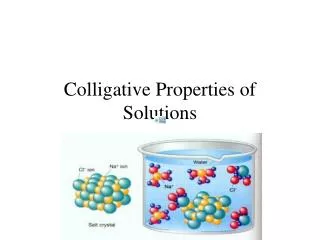
Ex. Electrolyte (i = ?) • IMPORTANT – the colligative properties of freezing point and boiling point are proportional to the number of particles present in the solution. • van Hoft factor, i • NaCl i = 2 moles Ie. 1m = 2m • CaCl2i = 3 moles Ie. 1m = 3m • Al2(SO4)3i = 5 moles Ie. 1m = 5m increasing colligative effect