Understanding Communication Disorders: Definitions, Prevalence, and Types
This informative video explores communication disorders, including speech and language disorders that impair the ability to transmit or receive ideas, facts, feelings, and desires. It covers various types of speech disorders, such as phonological, articulation, voice, fluency, and motor-speech disorders. Additionally, it discusses language disorders, their prevalence, and contextual factors that affect communication. The role of speech pathologists, classroom strategies, and accommodations for students with communication disorders are also highlighted.

Understanding Communication Disorders: Definitions, Prevalence, and Types
E N D
Presentation Transcript
Communication Disorders Jennifer Kuepper, Kayla Yates, Steven Otis, Ashley Roth http://www.youtube.com/watch?v=xCZ3jzMnlMw&feature=related
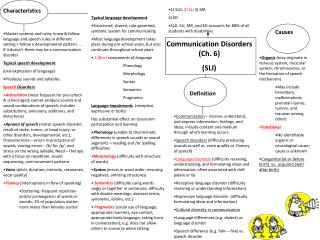
Definitions • Communication Disorder- impairs the ability to transmit or receive ideas, facts, feelings, and desires and may involve language or speech or both (listening, hearing, reading, or writing) • Speech Disorder-impairments in the production and use of oral language • Language Disorder-problems with comprehension and expression
Elements to Consider • Contexts in which communication occurs • Functions expressed by communication or the reasons for communication • Actual execution of communication comprehension and expression
Prevalence • Difficult to determine because of being extremely varied • Occurs as part of other disabilities • Intellectual disabilities, autism, brain injury, learning disability • Speech Pathologists • Pull-out • In classroom
Speech Disorders • Impairments in the production and use of oral language • Heterogeneous • Many different types, varying degrees, and combinations • Pose many challenges to communication
Speech Disorders cont. • Phonological Disorders-speech sound production is different from appropriate • Articulation Disorders-errors in producing sounds • Voice Disorders-characteristics of pitch, loudness, and/or quality that are abusive to the larynx • Fluency Disorders-efforts so intense or interruptions in flow of speech are so frequent or pervasive that affect understanding or communication • Motor-Speech Disorders-area of brain controlling speech muscles is damaged
Speech Disorders cont. • Fluency • Hunden er lilla. Han er en dejlig hund. Hunden kan lide at gå ture. Han kan lide at spille hente. • Mbwa ni ya rangi ya zambarau. Yeye ni mbwa nice. Mbwa anapenda kwenda kwa anatembea. Anapenda kucheza kuchota.
What it says • The dog is purple. He is a nice dog. The dog likes to go for walks. He likes to play fetch. • Danish • Swahili
Language Disorders • Problems with comprehension and expression • Primary Language Disorder- no known cause • Secondary Language Disorder- caused by another condition • Receptive Language disorder- unable to comprehend the language that others produce
Language Disorders cont. • Phonology- speech sounds • Morphology- internal organization of words • Syntax- organization of sentences • Semantics- attaching meanings and concepts to words • Pragmatics- using language for social purposes • One or combination of these involved in language disorder
In the Classroom • Facilitating social use of language • Question-Asking Strategies • Teaching literacy • Progress monitoring • Accommodations • Outcome measures
In the Classroom Cont. • Flash cards with words and pictures • Typey thingy 318
http://www.youtube.com/watch?v=gBzJGckMYO4 • Porky Pig That’s all Folks • http://www.youtube.com/watch?v=MUELu8o5KJg • Porky Pig’s Blue Christmas
If the known relation between the variables consists of a table of corresponding values, the graph consists only of the corresponding set of isolated points. If the variables are known to vary continuously, one often draws a curve to show the variation. • F.A.T. City