The Evolution of Renaissance Music: Josquin des Prez and the Shift to Imitative Counterpoint
210 likes | 315 Vues
Explore the transformation of music during the Renaissance through the lens of theorist insights from 1475. Featuring the celebrated composer Josquin des Prez, known as the "first great composer," discover his innovative techniques in the famous motet "Ave Maria... Virgo Serena" (1502). Delve into his approach to imitative counterpoint, juxtaposing traditional chant with complex vocal harmonies, and learn how Josquin's works influenced a new soundscape, characterized by careful dissonance handling and the captivating warmth of triads.


The Evolution of Renaissance Music: Josquin des Prez and the Shift to Imitative Counterpoint
E N D
Presentation Transcript
Renaissance Music in the
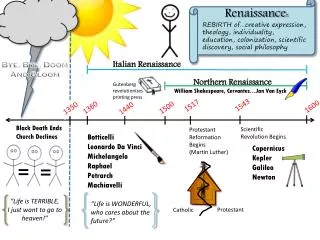
According to a theorist writing in 1475, no music worth hearing had been written before 1440 . . .
Josquin Desprez (des Prez) • 1st “Great Composer” glorified by contemporary and following generations • new approach to composition? Jos Canh duh Pray
Add a third active line that goes well with the cantus firmus and the other line Add a nice active line that goes well with the cantus firmus The Old Way Start with a bit of chant – a cantus firmus
The Emerging Way? Still very “linear” in conception, especially in its emphasis on IMITATIVE COUNTERPOINT, but more “vertical” in organization? (Careful control of dissonance; favoring triads.)
Compared to Ars Nova . . . • more careful handling of dissonance • more respect for the mode (less chromatic) • “sweeter” sound world favors the warm or sweet sound of 3rds & 6ths (intervals) instead of the stark, empty sounds of perfect 4ths & 5ths
Josquin listening example • KEY INFO: • motet -- Ave Maria. . . Virgo Serena, 1502, • Josquin (c. 1440-1521) • Imitative counterpoint 1480 Extra info: LINE, careful handling of dissonance. The shift to triple time and then back to duple near the end of a work is characteristic of many Renaissance works. Opening based on a chant fragment, but most of the work is freely invented anew.
Overlapping entry Overlapping entry Entry order: 1 2 3 4 time interval = 4 beats Entry order: 1 2 3 4 time interval = 5 beats Ave Maria. . . Virgo Serena Each phrase imitated by following voices Entry order: 1 2 3 4 time interval = 4 beats
slightly overlapping entry High duet (1 & 2) answered by low duet (3 4) + 3rd voice (2) brief break All 4 voices start rhythmically together but gradually create complex interlocking texture Ave Maria. . . Virgo Serena Entry order: 2 1 3 4 time interval = 4 beats
slightly overlapping entry 4 lines in imitation enter 1 2 3 4 at time intervals of 4, 2 & 4 beats Ave Maria. . . Virgo Serena Canonic duet (1 2) at a time interval of 1 beat answered by canonic duet in 3 & 4 Duet in 1 & 2 answered by duet in 3 & 4 Again, duet in 1 & 2 answered by duet in 3 & 4
Ave Maria. . . Virgo Serena TRIPLE METER lines generally together (a chordal, homorhythmic texture) but still independent – there is a hidden canon Text at this point?
Ave Maria. . . Virgo Serena back to duple Duet in 1 & 2 answered by duet in 3 & 4 That section is repeated note-for-note but with a different text Free imitation (lines 1 & 3 exact) Free imitation (lines 1 & 3 exact) Homorhythmic to the final “Amen”
Quite a career • Served in cathedrals and chapels of a wealthy family, the pope, and French royalty • Milan, Rome, Ferrara, Belgium & France • SIGNIFICANCE – this approach to music an international culture
for comparison • Memor esto, Josquin • Ave Maria, Ockeghem
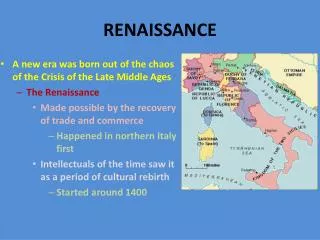
Summary – Italian Renaissance • POLITICS – Italian city-states; power from € (money) • EARLY RENAISSANCE – Florence • HIGH RENAISSANCE – Rome • ART – Classical ideals revived; BIG 3 • IDEAS – Humanism returns • MUSIC – Josquin & imitative counterpoint
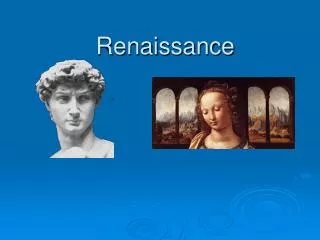
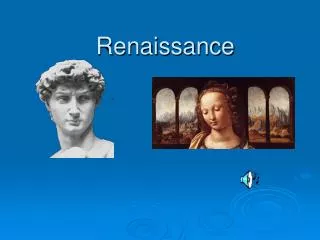
DATEBOOK 1432 – c.1500 – Donatello’s nude David Michelangelo’s David & Josquin’s Ave Maria . . . Virgo Serena(approximate date)
Josquin (to the tune of the Beatles’ “Michelle”) Josquin, the Man, Wrote smooth counterpoint as few persons can, That guy Josquin