Download

1 / 7
70 likes | 238 Vues
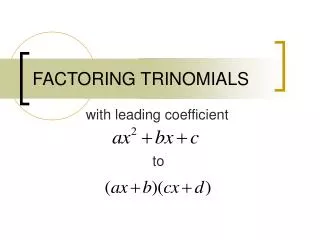
This guide provides a comprehensive approach to factoring trinomials, emphasizing the importance of identifying the Greatest Common Factor (GCF) first. With clear instructions on the tic-tac-toe method, you'll learn how to factor out common elements from each term effectively. The guide covers essential techniques, including how to handle negative leading terms and the importance of checking your work by multiplying across rows and up columns. Perfect for students and math enthusiasts, this resource simplifies the factoring process, ensuring accurate results every time.

E N D
Remember – always check for GCF first!! Factor out everything that ALL terms have in common. In this case, all numbers are even so they have a 2 in common, and each term has at least 1 x. Now, use the tic-tac-toe method on the trinomial. GCF? YES!! This sign tells you to Subtract The factors. This signs shows The sign of the Larger factor Don’t forget to check yourself, multiply ACROSS (L to R) all rows and UP all columns to see if you get the correct products. Now bring down your GCF!!!
GCF? YES!! • Remember – always check for GCF first!! • Factor out everything that ALL terms have in common. • In this case, all numbers have a 3 in common, and each term has at least 1 x. • Now, use the tic-tac-toe method on the trinomial. This signs shows The sign of the Larger factor This sign tells you to Subtract The factors. Don’t forget to check yourself, multiply ACROSS (L to R) all rows and UP all columns to see if you get the correct products. Now bring down your GCF!!!
GCF? YES!! Same steps as before!! Factor out EVERYTHING that ALL terms have in common. The numbers have 3 in common. What is the smallest exponent for “x”? So, each term has 2x’s in common. What is the smallest exponent on the “y”? So each term has 1 y in common. Now divide out the number and subtract the variables exponents. Now, use the tic-tac-toe method on the trinomial. (1)(20) (2)(10) (4)(5) Which one will subtract to give +8? (1)(4) or (2)(2) Which one? Multiply across the row for help! Now bring down your GCF!!!
GCF? YES!! Same steps as before!! Factor out EVERYTHING that ALL terms have in common. Now divide out the number and subtract the variables exponents (1)(6) or (2)(3) ??? Now, use the tic-tac-toe method on the trinomial. Now bring down your GCF!!!
GCF? YES!! What is different about this problem? When the leading term is negative, just factor out a negative number to make it positive!!!. Factor out EVERYTHING that ALL terms have in common. (1)(90) (2)(45) (3)(30) (5)(18) (6)(15) yes Now divide out the negative number!! Now, use the tic-tac-toe method on the trinomial. Now bring down your GCF!!!
GCF? YES!! When the leading term is negative, just factor out a negative number to make it positive!!!. Factor out EVERYTHING that ALL terms have in common. (1)(120) (2)(60) (3)(40) (4)(30) (5)(24) (6)(20) (8)(15) Yes (1)(20) (2)(10) (4)(5) yes – Look at last column. Now divide out the negative number!! Now, use the tic-tac-toe method on the trinomial. Now bring down your GCF!!!