New Graduate Student Guidance at Waseda University's Graduate School of Economics
This guide provides essential information for new graduate students at Waseda University's Graduate School of Economics, including academic programs, thesis requirements, advisor selection, and plagiarism warnings.

New Graduate Student Guidance at Waseda University's Graduate School of Economics
E N D
Presentation Transcript
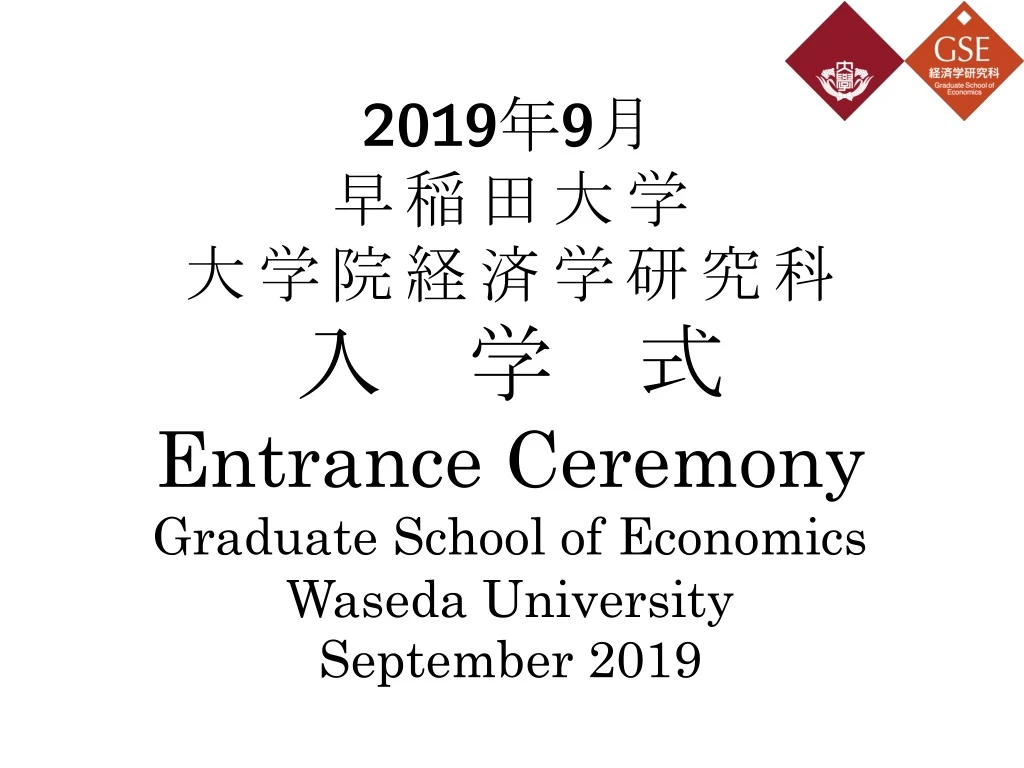
2019年9月早 稲 田 大 学大 学 院 経 済 学 研 究 科入 学 式EntranceCeremonyGraduate School ofEconomicsWaseda UniversitySeptember 2019
Self Introduction • Name (+English Name) • Hometown • Background • Interest, passion or goal • Hobbies
Guidance for New Grad Students KenichiroTaMakI, Associate Dean September 21, 2019
TOC • Academic Programs at GSE • Master Thesis • Advisor • Some Warnings
Graduate School of Economics Waseda University • Academic Programs: • Ordinary Mater Program • Empirical Analysis Program (EAP) • Ph.D. Program (5 years)
Ph.D. Program Interested in Ph.D. Degree? YES! No Interested in Empirical Study? Empirical Analysis Program (EAP) YES! No Empirical Study: - Data Analysis - Statistics - Econometrics Ordinary Master Program
Ordinary master Program (p. 13) COMPULSORY COURSE Select one course from Course Group Strongly Recommended
Ordinary Program • For students interested in … • Theory, History, Thought, Institution… • How to Enter the Program? • Nothing specially to do • Can I enter the Ph.D. course? • Excellent master thesis and high GPA • Thesis Type: Academic Paper
EAP (pp. 30-33) COMPULSORY COURSE Select one course from each course group
EAP (p. 32) Recommended for Micro Recommended for Macro
EAP • How to Enter the Program? • Register at the beginning of 2nd Semester • Can I quit the Program? • Yes (⇒ Ordinary Master Program) • Master Degree • Thesis Type: Research Paper
PH.D. PROGRAM(pp.34-35) Compulsory Selective
Ph.D. Program • How to Enter the Program? • Register at the beginning of 2nd Semester • Ph.D. Workshop for 2nd year students • Can I quit the Program? • Yes (⇒ Ordinary Master Program) • Master Degree • Thesis Type: Survey Paper
Academic Paper • Frontier research topic • Contains something new and original • Relatively long (15 pages or more) • Oral examination (15 min)
Research Paper(EAP) • Exercise of statistical methods • Relatively short (10-20 pages) • Appropriateness of statistical methods and forms of writings • Oral examination (15 min)
Survey Paper (Ph.D. program) • Literature review • Review 10-20 papers in your major field • Find your Ph.D. thesis topics • Oral examination (15 min)
3. Advisor • Determined by the end of 1st semester • It is very often that your first choice is rejected • To contact with a professor before you apply and to attend research seminars highly recommended
What Is Plagiarism? • Plagiarism is using another person's ideas or words without acknowledging the fact that those ideas/words came from someone else. Whether intentional or accidental, it is a serious academic crime.
What Is Plagiarism? • “Plagiarism is using another person's ideas or words without acknowledging the fact that those ideas/words came from someone else. Whether intentional or accidental, it is a serious academic crime.’’[1] • [1] Lincoln University, ‘Avoiding Plagiarism’ • URL: http://www.lincoln.edu/mhs/owl/plagiarism.html
What Is Plagiarism? • Citation is required whenever you • quote someone else's words directly, or • refer to someone else's ideas even paraphrased
Plagiarism(pp. 18-19) • Punishment is severe! • ※ Suspension • ※ Cancellation of All Credits • To avoid troubles… • See “RESEARCH ETHICS” (PP. 64-71, STUDY GUIDE for STUDENTS 2019)
Example 1 (p. 67) • Your text: • This statistical association between income and democracy is the cornerstone of the influential modernization theory. Democracy was both created and consolidated by a broad process of modernization which involved changes in the factors of industrialization, urbanization, wealth, and education [which] are so closely interrelated as to form one common factor. And the factors subsumed under economic development carry with it the political correlate of democracy. • Neither quotation marks nor explanatory comments are given.
Example 1 (p. 67) • Proper text: • This statistical association between income and democracy is the cornerstone of the influential modernization theory. Lipset (1959) suggested that democracy was both created and consolidated by a broad process of modernization which involved changes in “the factors of industrialization, urbanization, wealth, and education [which] are so closely interrelated as to form one common factor. And the factors subsumed under economic development carry with it the political correlate of democracy’’. • References • Lipset, Seymour M. 1959. “Some Social Requisites of Democracy: Economic Development and Political Legitimacy.” American Political Science Review, 53(1): 69-105
Example 2 (p. 67) • Original text: • The factors of industrialization, urbanization, wealth, and education [which] are so closely interrelated as to form one common factor. And the factors subsumed under economic development carry with it the political correlate of democracy. • Your text: • The factors of industrialization, urbanization, wealth, and education [which] are so closely related to each other so that they form one common factor. And the factors involved with economic development carry with it the political correlate of democracy. • Quotation marks are not necessary. • But explanatory comments are needed.
Commonly used excuses (p. 68) • It’s a coincidence! • I did it carelessly rather than on purpose. • An explanatory note is not necessary because I have the same opinion. • I did not know. I did not understand. • These claims are unacceptable
The following materials are all to be listed in the references: • Articles, Books, Blogs, Wikipedia, Movies, Newspapers, Magazines, Pictures, Illustration, PC program, Whatever written or made by someone else
‘‘Indicate clearly if you have written down a quotation directly in the author's words or if you are paraphrasing. ’’[2] • [2] Lincoln University, ‘Avoiding Plagiarism’ • URL: http://www.lincoln.edu/mhs/owl/plagiarism.html
Other examples… • Copied his/her friend’s paper (both punished) • Submit one paper to two classes • (Self-Plagiarism, see P. 19) • Used pictorial illustration without citation
Welcome to GSE, • Waseda University