Understanding C4 Photosynthesis: An Efficient Alternative to C3 Pathways
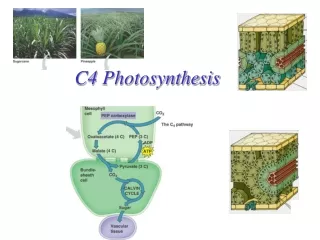
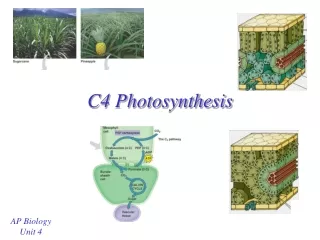
C4 photosynthesis represents an adaptive mechanism, primarily used by plants in dry, hot environments. Instead of the C3 process where carbon dioxide is fixed by rubisco to form PGA, C4 plants utilize phosphoenolpyruvate (PEP) to fix CO2 into oxaloacetate (OAA) with four carbons. This method reduces competition with oxygen, leading to decreased water loss and greater overall efficiency. Key processes involve the conversion of OAA to malate, which moves to bundle sheath cells, thus enhancing carbon fixation while minimizing stomatal opening. Examples include sugarcane and crabgrass.

Understanding C4 Photosynthesis: An Efficient Alternative to C3 Pathways
E N D
Presentation Transcript
C4 Photosynthesis Alternate pathway to C3 “dark reactions”
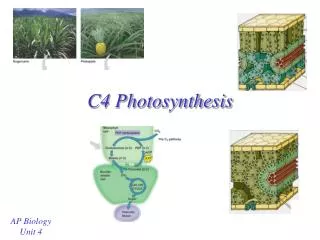
How it differs from C3 photosynthesis • Carbon dioxide is “fixed” by PEP to form OAA instead of carbon dioxide being “fixed by rubisco to form PGA • OAA (the first product made) has 4 carbons • Less oxygen to compete with • Water loss is reduced • Overall, more efficient than C3
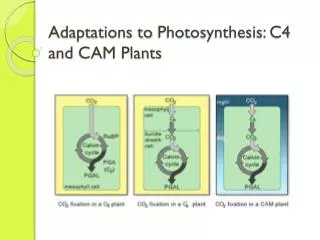
C4 Reaction Summary • Carbon dioxide enters leaf • Combines with PEP & “fixed” by PEP carboxylase to form OAA • OAA converted to malate • Malate sent to bundle sheath cells • Very little oxygen ever comes in contact with bundle sheath cells, making this cycle more efficient
Other things about C4 • Stomata doesn’t have to stay open as much • These plants found in dry, hot areas • Sugarcane and crabgrass are examples