Download
1 / 2
20 likes | 160 Vues
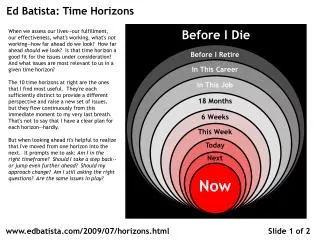
In "Time Horizons," Ed Batista invites us to reflect on how far ahead we should look when evaluating our lives and careers. He discusses ten distinct time horizons, from "Today" to "Before I Die," emphasizing their relevance in assessing effectiveness and fulfillment. This framework encourages us to consider if we are looking at the right timeframe for our current issues and prompts critical questions about our approach. Batista argues that varying our perspective can lead to more insightful reflections and better decision-making in our careers and personal lives.

E N D
Before I Die Before I Retire In This Career In This Job 18 Months 6 Weeks This Week Today Next Now Ed Batista: Time Horizons When we assess our lives--our fulfillment, our effectiveness, what's working, what's not working--how far ahead do we look? How far ahead should we look? Is that time horizon a good fit for the issues under consideration? And what issues are most relevant to us in a given time horizon? The 10 time horizons at right are the ones that I find most useful. They're each sufficiently distinct to provide a different perspective and raise a new set of issues, but they flow continuously from this immediate moment to my very last breath. That's not to say that I have a clear plan for each horizon--hardly. But when looking ahead it's helpful to realize that I've moved from one horizon into the next. It prompts me to ask: Am I in the right timeframe? Should I take a step back--or jump even further ahead? Should my approach change? Am I still asking the right questions? Are the same issues in play? www.edbatista.com/2009/07/horizons.html Slide 1 of 2
Before I Die In This Career 18 Months Today Now Ed Batista: Time Horizons I chose these specific horizons deliberately: Once I look beyond "Today" my next natural horizon is "This Week," and once I look past Friday the next signpost is a month-and-a-half out. And the "18 Month" horizon fits with Peter Drucker's belief that clear and specific plans can't cover any more time than that. You might choose a different set of horizons--perhaps "This Month" makes more sense to you than "6 Weeks." Or perhaps 10 horizons is too many, and it's more useful to think in broader strokes. For example, here’s an alternative version. The precise number and scope of the horizons is up to you--choose the ones that best meet your needs. But my larger point is that sometimes we're looking too far ahead when focusing closer in would be more useful, and sometimes we're staring down at our shoes when we really should lift our gaze. www.edbatista.com/2009/07/horizons.html Slide 2 of 2