
SlideServe
Menu
Préférences
© SlideServe · v2026

Understanding Exponents and Powers: Basics and Evaluations

lyre avatar
2 diapositives · 275 Views · Jul 14, 2014

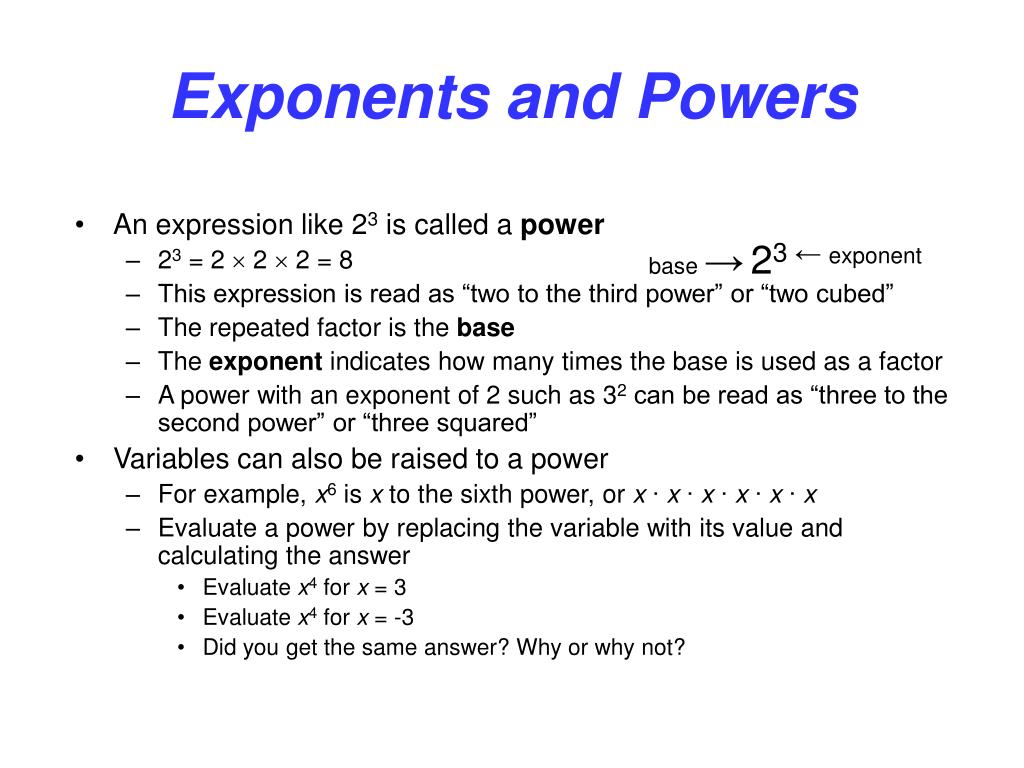
This guide introduces the concept of exponents and powers, explaining expressions like (2^3) (two to the third power or two cubed) and (3^2) (three to the second power or three squared). It covers how to identify the base and exponent, along with the use of variables raised to powers, such as (x^6). The section also emphasizes the importance of grouping symbols, like parentheses and brackets, in expressions, demonstrating their impact on calculations. Learn how to evaluate powers with examples and explore how input values affect results differently based on grouping.
Understanding Exponents and Powers: Basics and Evaluations - slide 1
01 / 2Understanding Exponents and Powers: Basics and Evaluations
1 / 17

Télécharger la présentation

Understanding Exponents and Powers: Basics and Evaluations
Une image / un lien ci-dessous est fourni (tel quel) pour télécharger la présentation

Politique de téléchargement : le contenu du site vous est fourni TEL QUEL pour votre information et votre usage personnel ; il ne peut être vendu, concédé sous licence ni partagé sur d’autres sites sans l’accord de son auteur.Le contenu vous est fourni TEL QUEL, pour votre information et votre usage personnel uniquement. Téléchargez la présentation en cliquant sur ce lien. Lors du téléchargement, si vous ne parvenez pas à télécharger une présentation, l’éditeur a peut-être supprimé le fichier de son serveur.Pendant le téléchargement, si vous ne parvenez pas à obtenir une présentation, le fichier a peut-être été supprimé par l’éditeur.

F I N

Plus de contenu associé

Transcription de la présentation
  1. Exponents and Powers • An expression like 23 is called a power • 23 = 2  2  2 = 8 • This expression is read as “two to the third power” or “two cubed” • The repeated factor is the base • The exponent indicates how many times the base is used as a factor • A power with an exponent of 2 such as 32 can be read as “three to the second power” or “three squared” • Variables can also be raised to a power • For example, x6 is x to the sixth power, or x ∙x ∙x ∙x ∙x ∙x • Evaluate a power by replacing the variable with its value and calculating the answer • Evaluate x4 for x = 3 • Evaluate x4 for x = -3 • Did you get the same answer? Why or why not? base →23 ←exponent

  2. Grouping symbols • Grouping symbols enclose parts of an expression that represent a single number • Parentheses ( ) • Brackets [ ] • Braces { } • Absolute value symbols | | also act as grouping symbols • A fraction bar is another grouping symbol • The numerator and denominator are separate expressions • Grouping symbols affect the result of power expressions • For example • -22 = -4, while (-2)2 = 4 • 1 + 23 = 9, while (1 + 2)3 = 27