Hydrocarbons
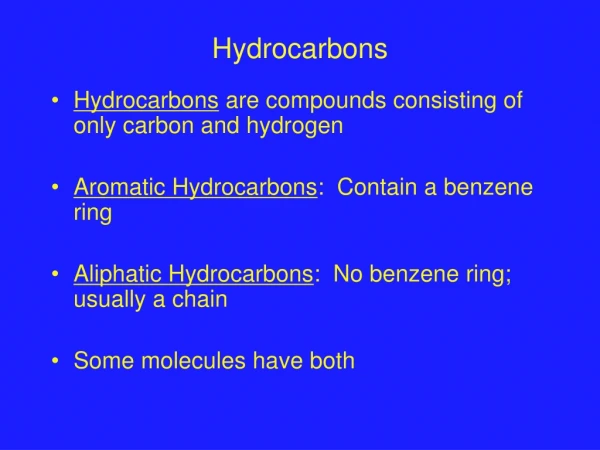
Hydrocarbons are organic compounds that consist of carbon and hydrogen. Carbon, possessing four electrons for bonding, can form single, double, or triple bonds. Alkanes are saturated hydrocarbons with only single covalent bonds, with methane (CH4) being the simplest example. Alkenes contain at least one double bond (e.g., ethene, C2H4), while alkynes have at least one triple bond (e.g., ethyne). Alcohols, composed of carbon, hydrogen, and oxygen, feature hydroxyl groups (-OH) and end in -ol. Learn about the structures and examples of these essential organic compounds.

Hydrocarbons
E N D
Presentation Transcript
Organic Compounds • Contain the element carbon, and usually hydrogen. • “Hydrocarbons”
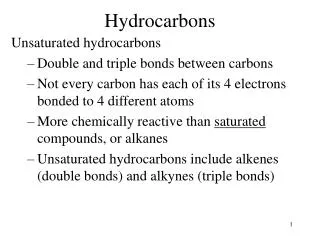
Carbon • Carbon has 4 electrons available for sharing. • Can form single, double, triple bonds. • Can never form more than four bonds.
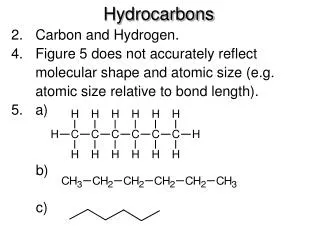
Alkanes • Hydrocarbons that have only single covalent bonds. • Simplest is CH4 (methane) • Carbons can also bond to carbons in alkanes. • Names always end in –ane.
Examples • ON BOARD!!!
Alkenes • Have at least one double bond. • Simplest is C2H4 (ethene) • End in -ene
Examples • ON BOARD!!!
Alkynes • Have at least one triple bond. • End in -yne
Examples • ON BOARD!!!
Alcohols • Organic compounds made of oxygen as well as carbon and hydrogen. • Hydroxyl groups (-OH) • End in –ol
Examples • ON BOARD!!!