Operations Strategy Overview
70 likes | 195 Vues
Operations strategy is crucial for guiding businesses in building operational capabilities that align with their competitive strategies for long-term success. This overview discusses the core components of operations strategy, including competitive priorities such as cost, quality, delivery performance, flexibility, and innovativeness. Additionally, it outlines strategic decision areas, distinguished between structural decisions (capacity, facilities, technology) and infrastructural policies (workforce practices, quality systems). Developing sustainable competitive advantages through these capabilities is emphasized as pivotal for enduring success.


Operations Strategy Overview
E N D
Presentation Transcript
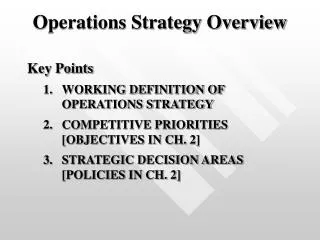
Operations Strategy Overview Key Points • WORKING DEFINITION OF OPERATIONS STRATEGY • COMPETITIVE PRIORITIES [OBJECTIVES IN CH. 2] • STRATEGIC DECISION AREAS [POLICIES IN CH. 2]
3 Keys For Understanding Operations Strategy[TOWARD A WORKING DEFINITION OF OPERATIONS STRATEGY] • Primary function of operations strategy is to guide business in forming a set of operations capabilities that enables the firm to pursue its chosen competitive strategy over the long-term • Pattern of Decisions • Consistency of Decisions Effective strategy
Capabilities-Based Competition • Strategic capabilities can result from investments in any function. Examples include outstanding marketing channels, prowess in logistics, or information processing capabilities, as well as through operations. • Capabilities are likely to produce a SUSTAINABLE advantage since capabilities are hard for competitors to duplicate. • Capabilities are built through a stream of investments over time. The capabilities themselves can be thought of as asset which can be deployed as needed. • Advantage built on product features, advertising, etc. is not necessarily sustainable since competitors can quickly imitate.
Competitive Priorities[OBJECTIVES] • Cost • Quality • Delivery performance • Flexibility • Innovativeness
Operations Strategy Decision Categories[POLICIES] STRUCTURAL DECISIONS – "BRICKS AND MORTAR” POLICIES • Capacity -- amount, timing, type • Facilities -- size, location, specialization • Technology -- equipment, automation, linkages • Vertical Integration -- direction, extent, balance
INFRASTRUCTURAL - POLICIES & SYSTEMS • Workforce policies and practices -- skill level, wage policies, training, and employment security • New product development process • Quality systems • Production Planning/Materials Control -- sourcing policies, centralization, decision rules • Organization