Download
1 / 19
190 likes | 282 Vues
Explore the pathways to reducing Disproportionate Minority Contact (DMC) in your community with actionable steps and assessments. Embrace acknowledgment, action, and acceptance towards DMC. Understand the do's and don'ts to make a positive impact. Engage with key agencies and individuals for effective solutions. Stay open-minded, address biases, and let data guide your efforts. Connect with initiatives and collaborate for lasting change. Make a difference by implementing concrete actions and staying focused on reducing DMC effectively.

E N D
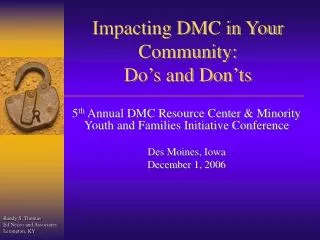
Impacting DMC in Your Community:Do’s and Don’ts 5th Annual DMC Resource Center & Minority Youth and Families Initiative Conference Des Moines, Iowa December 1, 2006
Pathway to DMC Reform Acknowledgment Action Acceptance Agreement
Personal/Community Assessment • Have I acknowledged that DMC exists in my community? • Has my community acknowledged that DMC exits?
Personal/Community Assessment • Have I accepted personal responsibility for my contributions to both the problems of and solutions to DMC? • Have all key agencies accepted responsibility for both the problems of and solutions to DMC? • Have all key individuals accepted personal responsibility for both the problems of and solutions to DMC?
Personal/Community Assessment • Has our DMC community/team reached agreement on the problem (or problem areas)? • Have we reached agreement on our focus? • Have we agreed on our desired outcomes? • Have we agreed on an action plan to address DMC? • Is our action plan designed to reduce DMC in the next one to two years?
Personal/Community Assessment • Has our community implemented specific activities to address DMC? • Have we maintained our focus on reducing DMC? • Do we have evidence that our efforts have impacted DMC?
DMC Do’s and Don’ts • Be open and willing to be uncomfortable with the subject • Be willing to confront your personal bias • Don’t let your uncomfortablness become a roadblock to action
Not everything that is faced can be changed, but nothing can be changed until it is faced. - James Baldwin
DMC Do’s and Don’ts • Don’t lose your sense of humor and ability to laugh at yourself and the absurd • Do lose your biases that impact the children and families you work with
DMC Do’s and Don’ts • Do collect data on all key decision points in the juvenile justice system • Don’t get sidetracked by data on community/individual social condition indicators (i.e., poverty, employment, graduation rates, etc.)
DMC Do’s and Don’ts • Let data guide you to further inquiry • Don’t be content with general observations about data (i.e., racial makeup of youth arrested, released, detained, etc.) • Be open to anything/anywhere the data leads you
DMC Do’s and Don’ts • Focus on the things you have control over (i.e., things that you can change) • Don’t get hung up on issues and problems that you cannot solve with your DMC efforts
DMC Do’s and Don’ts • Don’t work in isolation • Connect with all systems serving youth • Connect with other initiatives
Contact Information: Randy S. Thomas Ed Necco and Associates 503 Darby Creek Road Lexington, KY 40347 (859) 264-8732 RandyT@necco.org