
SlideServe
Menu
Préférences
© SlideServe · v2026

COMPOUND SENTENCE

mab avatar
7 diapositives · 299 Views · Jul 18, 2014

A compound sentence is a grammatical structure that joins two or more independent clauses using coordinating conjunctions or semicolons. These sentences communicate complete ideas and can be brief or complex based on the inclusion of modifiers. Utilizing transitional expressions enhances clarity and cohesion among clauses, providing a smooth flow in written communication. This guide explores the definition, construction, and examples of compound sentences, focusing on the correct use of punctuation and transitional phrases for effective expression.
COMPOUND SENTENCE - slide 1
01 / 7COMPOUND SENTENCE
1 / 17

Télécharger la présentation

COMPOUND SENTENCE
Une image / un lien ci-dessous est fourni (tel quel) pour télécharger la présentation

Politique de téléchargement : le contenu du site vous est fourni TEL QUEL pour votre information et votre usage personnel ; il ne peut être vendu, concédé sous licence ni partagé sur d’autres sites sans l’accord de son auteur.Le contenu vous est fourni TEL QUEL, pour votre information et votre usage personnel uniquement. Téléchargez la présentation en cliquant sur ce lien. Lors du téléchargement, si vous ne parvenez pas à télécharger une présentation, l’éditeur a peut-être supprimé le fichier de son serveur.Pendant le téléchargement, si vous ne parvenez pas à obtenir une présentation, le fichier a peut-être été supprimé par l’éditeur.

F I N

Plus de contenu associé

Transcription de la présentation
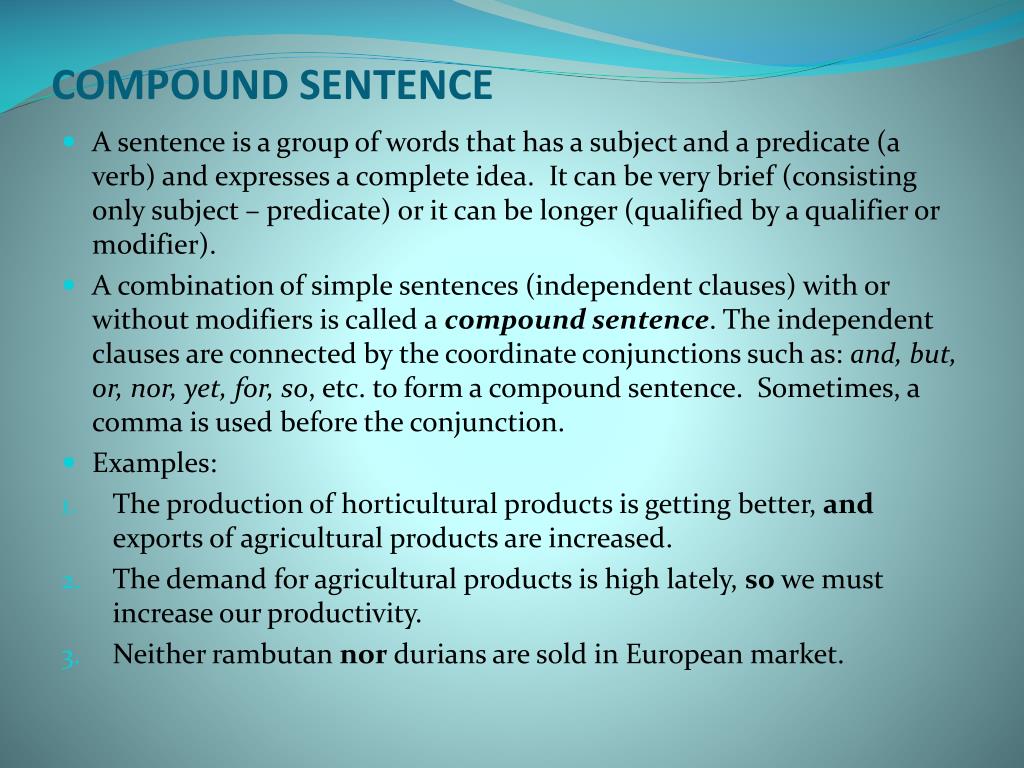
  1. COMPOUND SENTENCE • A sentence is a group of words that has a subject and a predicate (a verb) and expresses a complete idea. It can be very brief (consisting only subject – predicate) or it can be longer (qualified by a qualifier or modifier). • A combination of simple sentences (independent clauses) with or without modifiers is called a compound sentence. The independent clauses are connected by the coordinate conjunctions such as: and, but, or, nor, yet, for, so, etc. to form a compound sentence. Sometimes, a comma is used before the conjunction. • Examples: • The production of horticultural products is getting better, and exports of agricultural products are increased. • The demand for agricultural products is high lately, so we must increase our productivity. • Neither rambutannor durians are sold in European market.

  2. Using semicolon and transitional expression to form a compound sentence • Independent clauses (simple sentences) may also be joined together by using a semicolon with or without a transitional expression. When a transitional expression is used, it is placed in the between of a semicolon and a comma. Examples: • Banana is one of popular tropical crops in Indonesia; besides, it is also an export horticultural commodity. • Banana is one of popular tropical crops in Indonesia; it is also an export horticultural commodity. • Rose can grow in a wide range of elevation; however, it requires low temperature to produce seeds. • Rose can grow in a wide range of elevation;it requires low temperature to produce seeds.

  3. Transitional expressions indicating time (waktu):  Afterward (kemudian)  Earlier (terdahulu)  At the same time (sementaraitu)  In the mean time (sementaraitu)  Later (kemudian)  Meanwhile (sementaraitu)  Simultaneously (secaraserentak)  Soon (kemudian, segerasesudahnya) Transitional expressions indicating emphasis (penekanan): • Certainly (tentu) • Indeed (sesungguhnya) • In fact (sesungguhnya; nyatanya; padakenyataannya) • In short (pendek kata) • In truth (sebenarnya; sesungguhnya) • Of course (tentusaja; sudahbarangtentu; pastilah)

  4. Transitional expressions indicating addition (penambahan):  Again (lagi-lagi)  Also (juga)  Besides (lagi pula; disampingitu)  Equally important (samapentingnya)  Accordingly (sesuaidengan)  Therefore (maka; olehkarenaitu; olehsebabitu)  Thus (maka; jadi; dengandemikian)  In addition (selanjutnya; selainitu; tambahan pula)  Moreover (lagi pula)  Further (kemudian)  Furthermore (kemudian; selanjutnya) • Transitional expressions indicating place (tempat):  Beyond (diluar)  Here (disini)  There (disana)  Opposite (disebelah; dihadapan)  To the left (disebelahkiri)  To the right (disebelahkanan)

  5. Transitional expression as an interrupter or parenthetic element in a sentence • The words such as however, moreover, nevertheless, on the other hand, in fact, indeed, etc. are transitional expressions when they are placed in the between two (sometimes more) independent clauses to form a compound sentence. However, they may also function as interrupters when they are placed at the beginning, at the middle, or at the end of a sentence. As interrupters they are always separated by commas Consequently, a high concentration of plant growth regulators is required to induce callus proliferation.  A high concentration of plant growth regulators, consequently, is required to induce callus proliferation.  A high concentration of plant growth regulators is required to induce callus proliferation, consequently.

  6. However, callus formation is an undesirable phenomenon in a micropropagation system because it may induce genetic variation within the resulted progenies. • Callus formation, however, is an undesirable phenomena in a micropropagation system because it may induce genetic variation within the resulted progenies. • (You can not say: Callus formation is an undesirable phenomena in a micropropagation system because it may induce genetic variation within the resulted progenies, however).

  7. Assignment 1 Combine the pairs of the following independent clauses using semicolon and transitional expression given in the bracket. Make other changes as necessary and pay attention to your punctuation. • Nipahflourishes in the swampy areas of many islands in Indonesia. Indonesians have not discovered the potential of this palm (however). • Swampy areas stretch over large islands of Sumatra, Kalimantan and Irian. These areas are also found in islands such as Bangka and Belitung (in fact). • Swampy regions are subjected to ocean tides. These areas can be reclaimed for agricultural purposes (simultaneously). • Sugar and alcohol can be produced from nipah plant. Nipahplants have a great economic value (therefore). • The leaves of nipah can be used for roofing materials. The jelly-like, sweet endosperm of young fruits is edible (in addition).