Download
1 / 14
140 likes | 283 Vues
The SEXSI Survey investigates a sample of high-redshift type 2 quasar candidates utilizing optical and X-ray data. Key highlights include the optical/X-ray sample composition, Spitzer data covering five SEXSI fields, and a peak redshift distribution around 0.7. The survey identified 438 spectroscopic redshifts with a focus on understanding X-ray binary contributions. With 62% of X-ray sources identified and analyzed, the data reveals critical insights into the fraction of obscured sources and their spectral energy distributions (SEDs). Ongoing work includes synthesizing spectrally identified and unidentified SEDs.

E N D
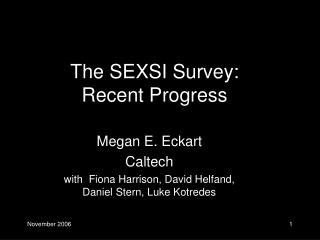
The SEXSI Survey: Recent Progress Megan E. Eckart Caltech with Fiona Harrison, David Helfand, Daniel Stern, Luke Kotredes
Overview • Introduction to the SEXSI sample and optical followup • Highlights of the optical/X-ray sample composition • Spitzer data • high-z type 2 quasar candidates • SED’s of spectroscopically ID’d sources
SEXSI Survey • Study dominant contributors to XRB • 1034 2-10 keVsources from 27 Chandra pointings; (2 deg2) • R-band imaging • 438 spectroscopic redshifts from Keck • Harrison et al. 2003, ApJ, 596, 944-956 (Paper 1)
SEXSI Survey • Harrison et al. 2003, ApJ, 596, 944-956 (Paper 1)
Redshift Distribution • Peak: z ~ 0.7 • 34 narrow-lined Lx>1044 sources(type-2 quasar candidates) • nine z > 2, obscured type-2 quasar candidates • Eckart et al. 2006, ApJS, 165, 19-56 (Paper 3)
Fraction Obscured • SEXSI - excellent statistics over flux range ~50% obscuredindependent of luminosity Fraction with log(NH) > 22 log (Unobscured 2-10 keV Luminosity [erg s-1]) • Eckart et al. 2006, ApJS, 165, 19-56 (Paper 3)
Spitzer Data • Spitzer data over five SEXSI fields (IRAC & MIPS) • 250 SEXSI X-ray sources covered • 140 with spectroscopic ID • 62% of total X-ray sources are in “wedge” • 86% of BLAGN • 67% of NLAGN • 28% of ELG • 15% of sources with Lx<10 43.5 erg s-1 • - wedge from Stern et al. (2005)
High-z QSO 2 • - quadrant split from Martinez-Sansigre, Lacy et al. (2005)
High-z QSO 2 • - quadrant split from Martinez-Sansigre, Lacy et al. (2005)
log (n [Hz]) log (n [Hz]) BLAGN SED’s • Many BLAGN fit a typical quasar SED (Elvis et al. 1994) • BUT, there are many that fit a star forming template better in mid-IR/optical (Devriendt et al. 1999 template plotted above)
log (n [Hz]) log (n [Hz]) NLAGN SED’s • Bad match to both templates • (would match an absorbedAGN spectrum …) • Fits star forming template in IR
log (n [Hz]) ELG SED’s • Overwhelming majority (but not all) of ELG fit starforming template
In Progress… Synthesis of spectrally identified and unidentified SED’s X-ray stacking of Spitzer sources with Chandra nondetections Acknowledgements: Fiona Harrison, David Helfand, Dan Stern, Luke Kotredes