Texas Springs: Navigating the Challenges of Groundwater Decline and Ecological Health
210 likes | 336 Vues
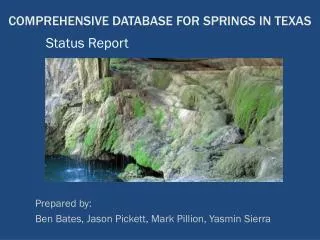
Texas Springs play a crucial role as sources of groundwater, supporting diverse ecosystems and human needs. In 2003, groundwater accounted for 59% of water use in Texas. With the population projected to double by 2060 and significant groundwater level declines expected over the next 50 years, the future of these vital springs remains uncertain. Springs serve as ecological barometers and are essential for wildlife, yet many are vanishing. To ensure sustainability, we must improve our understanding of groundwater and surface water interactions, and prioritize conservation and management efforts.


Texas Springs: Navigating the Challenges of Groundwater Decline and Ecological Health
E N D
Presentation Transcript
Texas Springs: leaking into an uncertain future Chad Norris Water Resources Branch Chad.norris@tpwd.state.tx.us (512) 389-8761
GROUNDWATER • Supplied 59% of water used in TX in 2003 • Population expected to double by 2060 • GW level declines predicted for many aquifers over next 50 years (TWDB 2007) • Impacts to groundwater dependent habitats (e.g. springs) unclear San Antonio Springs
What is a Spring? • The natural flow of groundwater to the land surface or a surface water body • Artesian or gravity • Ephemeral, intermittent, or perennial • May form marshes, ponds, or streams • A springs characteristics is largely determined by hydrogeologic setting
Edwards Plateau Springs Edwards-Trinity (Plateau) Aquifer
Texas Springs • Major and Historical Springs of Texas (TWDB Report 189) • Documented loss and decline of Tx Springs • 65 of 281 (23%) springs no longer flowed • Only 2 of 4 largest springs remained
Texas Springs • Springs of Texas Vol. 1, 1981 – Gunnar Brune • Describes about 2,000 springs from 183 TX counties • Further documented loss and decline of TX springs
United States Geological Survey Springs (Heitmuller and Reece 2004)
Gillespie Kerr Real Bandera
Importance of Springs • Recognized as valuable ecological, natural, and cultural resources • Barometer of local hydrologic conditions and watershed health • Generally a source of high quality water – increases assimilative capacity
Importance of Springs • Water source for local wildlife • Often only perennial water source • Significant component of natural flow regime in many streams – “baseflows” • Unique aquatic habitats that often sustain high degree of diversity
Springs - Natural Flow Regime • Often compose significant portion of streamflow – especially in arid west • Provide baseflows to streams and rivers • Sustain aquatic and riparian habitats during drought - perennial vs. intermittent • Historically reliable water supply • Primary source of recharge during drought • Affects property values
Gaining vs. Losing Streams Gaining Stream Losing Stream
Springs - Natural Flow Regime • Kansas rainfall 15-20 in/yr in West and 40-45 in East • GW use from High Plains Aquifer in west is high • Gaining streams turned to losing streams (Sophocleous and Wilson 2000)
Springs - Unique Aquatic Habitats • Transition between groundwater and surface water habitats – “Ecotone” • Thermally and hydrologically stable habitats • Commonly harbour rare, endemic, or relict species • Provide refuge for common species
Spring-dependent Fish Plateau shiner – Cyprinella lepida Greenthroat darter (Etheostoma lepidum)
Common Fish Species Longear sunfish (Lepomis megalotis) Central Stoneroller (Campostoma anomalum) Green sunfish (Lepomis cyanellus) Mexican tetra (Astyanax mexicanus)
Mayflies Beetles Damselflies & Dragonflies Aquatic Macroinvertebrates of Springs Crustaceans Caddisflies True Bugs Snails
Conservation Issues • Majority of Springs on Private Property • Recharge features and flow system rarely on same property • Sustainable use of aquifers • Texas water law does not adequately address GW/SW interactions • GW – Rule of Capture; GCD’s, GMA’s • SW – Prior appropriation
How can we conserve springs? • Identify springs and gather baseline data • More hydrogeologic information needed • Identify major outlets of aquifers and associated recharge features, flow paths, and residence times • Address connected nature of GW and SW • Require large-scale GW pumping to assess impacts on springs and SW • Holistic watershed management • Outreach and education
Texas Springs: leaking into an uncertain future Chad Norris Water Resources Branch Chad.norris@tpwd.state.tx.us