Download
1 / 5
50 likes | 185 Vues
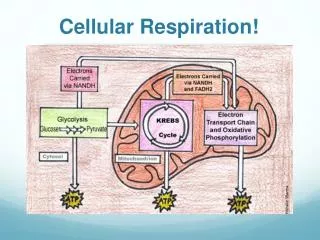
The Krebs Cycle, also known as the TCA or Citric Acid Cycle, is a fundamental process in cellular metabolism. It converts acetyl-CoA into energy, producing essential molecules like NADH and FADH2, which fuel ATP synthesis. The cycle includes eight key intermediates: citrate, isocitrate, α-ketoglutarate, succinyl-CoA, succinate, fumarate, malate, and oxaloacetate, facilitating reductions and decarboxylations that release CO2 and generate energy. This efficient sequence is critical for energy production in aerobic organisms.

E N D
Cellular Energy – The Krebs cycle aka TCA -- Tricarboxylic Acid Cycle aka CAC -- Citric Acid Cycle
H2O CO2 CO2 CO2 acetyl-CoA Kreb’s Cycle citrate pyruvate from glycolysis NADH oxaloacetate isocitrate malate NADH a-keto glutarate fumarate FADH2 succinyl Co-A succinate ATP NADH
ADP --> ATP ADP is phosphorylated to ATP. High-energy bond is formed. (in this case a GDP -->GTP happens first, which immediately phosphorylates an ADP) Water is added to a molecule. H2O Carbon dioxide is removed from a molecule. CO2 the actions NAD+ is reduced to NADH + H+ (aka NADH2 or NADre) NAD has accepted a high-energy electron -- it will hold the energy until needed in another part of the cycle. (Nicotinamide adenine dinucleotide) FAD+ is reduced to FADH + H+ (aka FADH2 or FADre) similar in function to NAD (Flavin adenine dinucleotide)
The players Citrate -- SIT-rate -- 6 carbon 1. Isocitrate -- I-so-sit-rate -- 6 carbon 2. a-ketoglutarate -- AL-fa-KEY-to-GLU-ter-ate -- 5 carbon 3. 4. Succinyl-CoA -- SUX-in-ul KO-a -- 4 carbon 5. Succinate -- SUX-in-ate -- 4 carbon 6. Fumarate -- FYUM-ar-ate -- 4 carbon 7. Malate -- MAL-ate -- 4 carbon 8. Oxaloactetate -- ok-SAL-o-ASS-uh-tate -- 4 carbon Acetyl-CoA -- ah-SEET-ul KO-a -- 2 carbon
H2O CO2 CO2 Summary of Actions: Kreb’s Cycle 8 “players” 3 reductions of NAD+ to NADH 2 CO2 molecules given off for EACH PYRUVIC ACID that enters the Kreb’s cycle-- therefore DOUBLE that for each GLUCOSE 1 FAD+ reduced to FADH2 1 ATP molecule (from GTP) 1 molecule of H2O added (net)