Light and Atomic Spectra
110 likes | 234 Vues
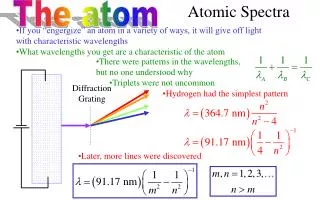
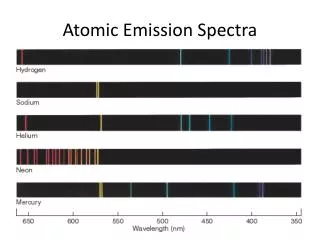
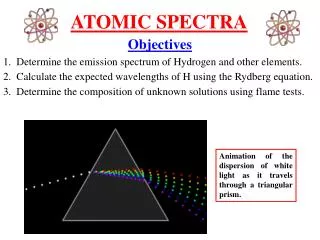
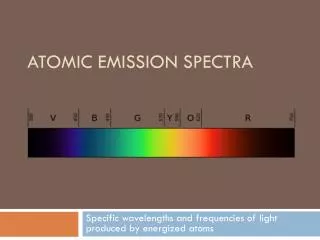
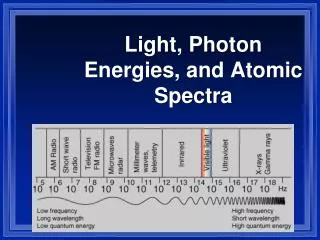
This article explores the fundamental concepts of light, atomic spectra, and their properties. It explains the importance of wavelength, represented by Lambda (λ), as the distance between two consecutive crests or troughs, and frequency, symbolized by nu (ν), as the number of wave cycles passing a point in unit time (Hz). The relationship between wavelength and frequency is highlighted by the formula c = λ × ν, with the speed of light (c) being approximately 2.998 × 10^8 m/s. Additionally, the article discusses photons, line spectra, and flame tests in the context of the electromagnetic spectrum.


Light and Atomic Spectra
E N D
Presentation Transcript
Wavelength • The distance between two consecutive crests or troughs • Symbolized by Lambda (l)
Frequency • The number of wave cycles that pass a given point in unit time. • Unit is hertz (Hz) • Symbolized by nu (n)
c = l x n • Speed of light = wavelength x frequency • c = 2.998 x 10⁸ m/s
Photons • Stream of particles with properties of both waves and matter