Download
1 / 11
110 likes | 235 Vues
This research investigates the question: why is the sky blue? Through a thorough examination of light wavelengths and the role of the atmosphere, we explore the interaction between sunlight and air particles. Our hypothesis considers both the null hypothesis—suggesting no significant effect of the atmosphere on sky color—and an alternative hypothesis affirming its influence. By analyzing our experimental results, we aim to clarify the mechanisms underlying this common phenomenon and lead us to a deeper understanding of atmospheric science.

E N D
Descriptive But Catchy Title With an informative subtitle if necessary Names of entire team
Background information Background information should be informative information about the topic of your research. It should lead the audience to ask the same question that you did. This may take up to two or three slides. While it is very important information, you should consider carefully how much detail you add. If you add too much, the audience will get bored. If you add too little, the audience will get lost. You simply want to lead the audience through your thought process as to why you did this experiment. You may need to cite scientific papers here. If so, you put the author’s name in parentheses with the date of the publication. Then, at the end of the slideshow, put the full citation in a references slide.
Bullet Points for Information • Background information • Lead to question • 2-3 slides • Careful with amount of detail • Cite scientific papers
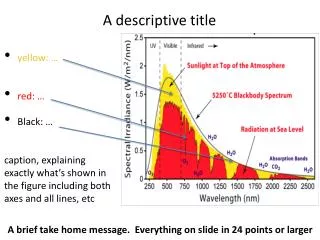
Your question • Why is the sky blue? • Because space is blue • Because the atmosphere is blue • Because water is blue • It’s not you just see it that way Because the atmosphere is blue
Hypotheses • Null Hypothesis – NO EFFECT • The presence of the atmosphere has no effect on the color of the sky • Alternative Hypothesis – EFFECT • The presence of the atmosphere has an effect on the color of the sky
Predictions • We will remove the atmosphere • If the wavelength of light remains the same, we will accept the null hypothesis. • If the wavelength of light changes, we will reject the null hypothesis.
Methods • Very basic • Variables • Measurements • Sample size
Results • GRAPH! A B C D Group
Results • Or on RARE occasion Table. • Must be clear and large type
Discussion or Conclusions • Null Hypothesis • Accept or reject • What your results mean • Where your results fit • Cite if necessary
References Author, C. 2001. How do I cite you, let me count the ways? Journal of Citations. 4(1):312-324.