Combinations of Functions
Combinations of Functions. Objective. To be able to perform operations and combinations of functions algebraically, graphically, and with the use of technology. Relevance. To be able to model a set of raw data after a function to best represent that data.

Combinations of Functions
E N D
Presentation Transcript
Objective • To be able to perform operations and combinations of functions algebraically, graphically, and with the use of technology.
Relevance • To be able to model a set of raw data after a function to best represent that data.
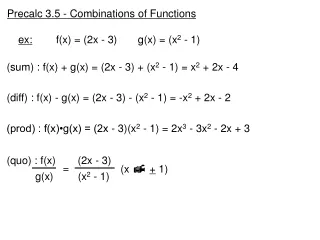
Operations with Functions: • Sum • Difference • Product • Quotient
Find f + g Find f - g Example: Let f(x) = 5x² -2x +3 and g(x) = 4x² +7x -5
Using your GDC Start with “VARS”
Find f · g Find f/g Example: Let f(x) = 5x² and and g(x) = 3x – 1.
Find: + 4 = 5 1
Find: = - 4 0 + - 4
Find: 0 - 4 = - 4
Find: 3 - (- 4) = 7
Find: 5 x 4 = 20
Find: - 3 x 5 = - 15
Find: 6 3 = 2
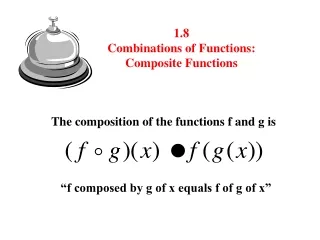
A composite function is a combination of two functions. • You apply one function to the result of another.
The composition of the function f with the function g is written as f(g(x)), which is read as ‘f of g of x.’ • It is also known as which is read as ‘f composed with g of x.” • In other words:
Ex: f(x)=2x + 5 and g(x) = x - 3 • You can work out a single “rule” for the composite function in terms of x.
Do you think will give you the same result? NO!
You Try…. f(x) = 2x + 2 g(x) = (x + 2)2 Find:
You may need to evaluate a composite function for a particular value of x. Method 1: Work out the composite function. Then substitute 3 for x.
You may need to evaluate a composite function for a particular value of x. Method 2: Substitute 3 into g(x). Substitute that value into f(x).