Neural Dynamic Programming for Automotive Engine Control
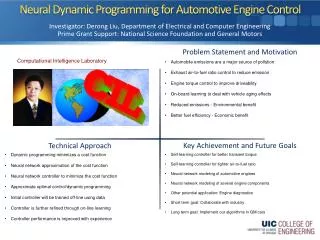
This research focuses on advanced neural dynamic programming techniques for optimizing automotive engine control. The primary goals are to enhance exhaust air-to-fuel ratio control to minimize emissions, improve engine torque for better driveability, and implement on-board learning to adapt to vehicle aging effects. By employing a neural network to approximate the cost function, we aim for reduced emissions and improved fuel efficiency. The project will involve offline training of initial controllers, which will then be refined through online learning, ultimately resulting in self-learning controls for better performance in General Motors vehicles.

Neural Dynamic Programming for Automotive Engine Control
E N D
Presentation Transcript
Neural Dynamic Programming for Automotive Engine Control Investigator: Derong Liu, Department of Electrical and Computer Engineering Prime Grant Support: National Science Foundation and General Motors Computational Intelligence Laboratory • Automobile emissions are a major source of pollution • Exhaust air-to-fuel ratio control to reduce emission • Engine torque control to improve driveability • On-board learning to deal with vehicle aging effects • Reduced emissions - Environmental benefit • Better fuel efficiency - Economic benefit • Dynamic programming minimizes a cost function • Neural network approximation of the cost function • Neural network controller to minimize the cost function • Approximate optimal control/dynamic programming • Initial controller will be trained off-line using data • Controller is further refined through on-line learning • Controller performance is improved with experience • Self-learning controller for better transient torque • Self-learning controller for tighter air-to-fuel ratio • Neural network modeling of automotive engines • Neural network modeling of several engine components • Other potential application: Engine diagnostics • Short term goal: Collaborate with industry • Long term goal: Implement our algorithms in GM cars