

SlideServe
Menu
Préférences
© SlideServe · v2026

Fractals

madge avatar
34 diapositives · 641 Views · Jul 31, 2014

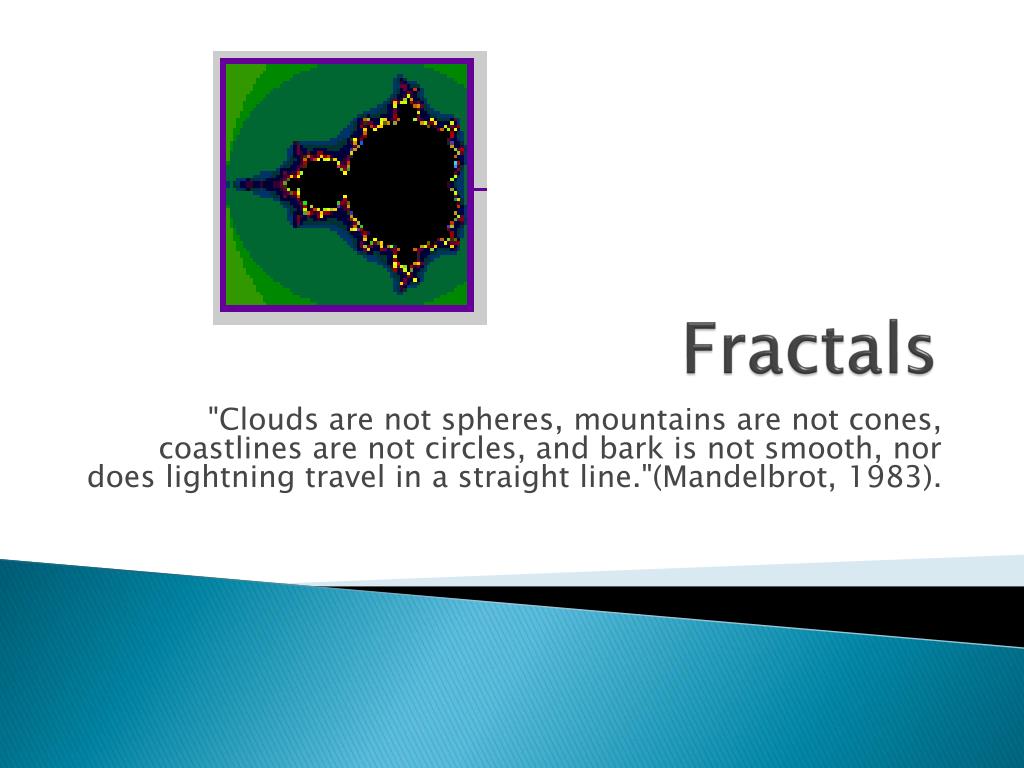
Fractals. "Clouds are not spheres, mountains are not cones, coastlines are not circles, and bark is not smooth, nor does lightning travel in a straight line."(Mandelbrot, 1983). Fractals.
Fractals - slide 1
01 / 34Fractals
1 / 17

Télécharger la présentation

Fractals
Une image / un lien ci-dessous est fourni (tel quel) pour télécharger la présentation

Politique de téléchargement : le contenu du site vous est fourni TEL QUEL pour votre information et votre usage personnel ; il ne peut être vendu, concédé sous licence ni partagé sur d’autres sites sans l’accord de son auteur.Le contenu vous est fourni TEL QUEL, pour votre information et votre usage personnel uniquement. Téléchargez la présentation en cliquant sur ce lien. Lors du téléchargement, si vous ne parvenez pas à télécharger une présentation, l’éditeur a peut-être supprimé le fichier de son serveur.Pendant le téléchargement, si vous ne parvenez pas à obtenir une présentation, le fichier a peut-être été supprimé par l’éditeur.

F I N

Plus de contenu associé

Transcription de la présentation
  1. Fractals "Clouds are not spheres, mountains are not cones, coastlines are not circles, and bark is not smooth, nor does lightning travel in a straight line."(Mandelbrot, 1983).

  2. Fractals "Clouds are not spheres, mountains are not cones, coastlines are not circles, and bark is not smooth, nor does lightning travel in a straight line."(Mandelbrot, 1983). Definition: A fractal is an object or quantity that displays self-similarity, in a somewhat technical sense, on all scales. - Wolfram MathWorld

  3. Dimension 0

  4. Dimension 1

  5. Dimension 2

  6. Dimension 3

  7. Fractional Dimension

  8. Self-similar

  9. Self-similar

  10. Self-similar

  11. Do you see the pattern?

  12. Formula for Dimension

  13. Sierpinski Triangle • Start with a Sierpinski triangle of 1-inch sides. • Double the length of the sides. • Now how many copies of the original triangle do you have? • Remember that the black triangles are not a part of the Sierpinski triangle

  14. Sierpinski Triangle • Doubling the sides gives us three copies, so 3 = 2 d, where d = the dimension.

  15. Fractional Dimension • But wait, 2 = 2 1 , and 4 = 2 2 , so what number could this be? It has to be somewhere between 1 and 2, right? Let's add this to our table.

  16. How can we solve for d? • For the Sierpinski triangle consists of 3 self-similar pieces, each with magnification factor 2

  17. Koch Curve • We begin with a straight line of length 1, called the initiator. We then remove the middle third of the line, and replace it with two lines that each have the same length (1/3) as the remaining lines on each side. This new form is called the generator, because it specifies a rule that is used to generate a new form.

  18. Koch Curve Level 2 • The rule says to take each line and replace it with four lines, each one-third the length of the original • You try to draw level 3.

  19. Koch Curve Level 3 • The rule says to take each line and replace it with four lines, each one-third the length of the original

  20. Koch Curve We do this iteratively ... without end. The Koch Curve.

  21. What is the length of the Koch curve?

  22. Koch Snowflake

  23. Koch Snowflake

  24. What is the fractional Dimension of the Koch Curve?

  25. What is the fractional Dimension of the Koch Curve? Each line has become 4 self-similar copies with 3 for scaling factor! D = log(N)/log(r) D = log(4)/log(3) = 1.26

  26. Cantor Dust Iteratively removing the middle third of an initiating straight line, as in the Koch curve, ... Initiator and Generator for constructing Cantor Dust. ... this time without replacing the gap... Levels 2, 3, and 4 in the construction of Cantor Dust.

  27. Cantor Dust • Calculating the dimension ... D = log(N)/log(r) • D = log(2)/log(3) = .63 • We have an object with dimensionality less than one, between a point (dimensionality of zero and a line (dimensionality 1).

  28. Sierpinski Carpet

  29. Sierpinski Carpet • The Sierpinski carpet is a plane fractal first described by Wacław Sierpiński in 1916. The carpet is a generalization of the Cantor set to two dimensions (another is Cantor dust)

  30. Sierpinski Carpet • What is the fractional dimension?

  31. Sierpinski Carpet • In the fractal, there are 8 identical figures, each of which has to be magnified 3 times to get the entire figure. • D= log 8 / log 3 which is approximately 1.89.

  32. Menger Sponge

  33. Menger Sponge

  34. Menger Sponge • It's fractal dimension equals log 20 / log 3, approximately 2.73