Catabolic Pathways of Lipids in Adipose Tissue: Energy Production and Synthesis Mechanisms
Adipose tissue is primarily composed of triglycerides, which serve as an essential energy source and offer insulation and minor protection. The hydrolysis of triglycerides yields glycerol and fatty acids, which undergo β-oxidation, a series of enzyme-catalyzed reactions that break down fatty acids to produce acetyl-CoA. Each cycle yields energy, with an 18-carbon fatty acid generating up to 146 ATP. Meanwhile, fatty acid synthesis occurs in the cytosol using acetyl-CoA as a building block, facilitated by the acyl carrier protein, which assists in the process by rotating and delivering carbon units for fatty acid elongation.

Catabolic Pathways of Lipids in Adipose Tissue: Energy Production and Synthesis Mechanisms
E N D
Presentation Transcript
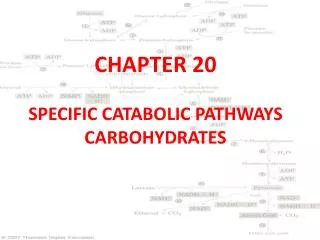
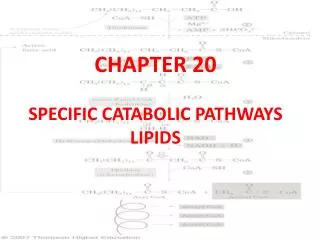
CHAPTER 20 SPECIFIC CATABOLIC PATHWAYS LIPIDS
ADIPOSE TISSUE • 90% of adipose tissue is triglycerides • It supplies energy. • Insulation. • Provides minor physical protection • Cholestrol storage
GLYCEROL GLUCOSE GLYCOLYSIS PYRUVATE
b-Oxidation • -Oxidation: a series of five enzyme-catalyzed reactions that cleaves carbon atoms two at a time from the carboxyl end of a fatty acid. • Reaction 1: the fatty acid is activated by conversion to an acylCoA
-OXIDATION Blue box = carbon Red box = acetyl CoA
-OXIDATION • Activation by addition Coenzyme-A • carbon oxidized from CH2 to C=O (ketone) • Molecule split into acetyl CoA and Fatty acid 2 carbons shorter • Another Coenzyme-A added to shortened Fatty acid
Each cycle produces 1 acetyl-CoA 18 carbon fatty acid would give 9 acetyl-CoA Cycles required is # of carbons/2 – 1 18 carbon fatty acid would require 8 cycles Amount of energy from Fatty Acid depends on length of carbon chain 18 carbon fatty acid would give 146 ATP
Fatty Acid Biosynthesis • While degradation of fatty acids takes place in mitochondria, the majority of fatty acid synthesis takes place in the cytosol. • These two pathways have in common that they both involve acetyl CoA. • Acetyl CoA is the end product of each spiral of b-oxidation. • Fatty acids are synthesized two carbon atoms at a time. • The source of these two carbons is the acetyl group of acetyl CoA. • The key to fatty acid synthesis is a multienzyme complex called acyl carrier protein, ACP-SH.
Fatty Acid Biosynthesis • ACP has a side chain that carries the growing fatty acid • ACP rotates counterclockwise, and its side chain sweeps over the multienzyme system (empty spheres).