Integrating Paper and Digital: The Evolving Landscape of Interactive Texts
220 likes | 352 Vues
This discussion explores the integration of paper and digital content through innovative interactive texts. With the rise of hypertext, chatterbots, and email, readers' engagement has shifted, yet many still discount online reading despite its prevalence. We examine how fluid texts and new authoring techniques, such as Embedded Media Markers, can enhance the interaction between authors and readers. Additionally, we consider challenges in the design and implementation of effective digital links in traditional media, along with future advancements in technologies like E-Ink and flexible OLED displays.


Integrating Paper and Digital: The Evolving Landscape of Interactive Texts
E N D
Presentation Transcript
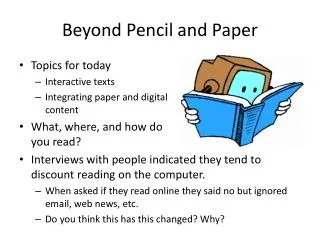
Beyond Pencil and Paper • Topics for today • Interactive texts • Integrating paper and digital content • What, where, and how do you read? • Interviews with people indicated they tend to discount reading on the computer. • When asked if they read online they said no but ignored email, web news, etc. • Do you think this has this changed? Why?
Interactive Texts • Many forms of interactive text • Hypertext • Chatterbots • Computer-generated texts • Social texts (email, etc.) are for next class so let’s ignore them for now • How do these forms of text change the connection between the author and reader? • What are they good for?
Fluid Texts • Stretchtext • Fine grained hypertext structure • Differs from the web • Novel animated text to maintain reader context • Differs from traditional hypertext where the new lexia replaces (or opens in a separate window) from the prior lexia • Authoring is still a challenge
Integrating Paper and Digital • We see it all the time • Barcodes • QR codes • TAG codes • Characteristics • Visible • Takes space from other content • No features of the link are human interpretable • May not fit into the aesthetic of linked content
Code-base Invisible Links • We don’t see it all the time • RFID • Data glyphs • Anoto • Characteristics • Rely on special hardware • Not human interpretable • Does not take space • Does not interfere with aesthetic
Links from Content • Can we create links from standard paper content without augmented technology or visible marks? • 1st possibility: Use the text (OCR) • What are the limitations? • 2nd possibility: Treat as a photo • How to index?
The Big Issue • Relying on a camera • Scale, skew, parallax • Scale Invariant Feature Transform • Features that are resilient to different angles • Used for lots of image recognition tasks
Links Using SIFT (or Similar) Features • Links can be from text and image content but • Printed text is not good for distinctive SIFT features • Could combine with lossy OCR • Readers • Do not know where there is a link and where there is not a link • Do not know the boundary of links
EMM Characteristics • Printed as an layer on top of existing content • Does not take space but can impact aesthetics • Readers know where links are • Readers have some information about results of taking a link • Challenges • Recognition still has problems of SIFT features • Need authoring support for unambiguous EMMs
Towards Paper and Digital • Older and Newer technologies • E Ink • Flexible OLED