
DNA Technologies
E N D
Presentation Transcript
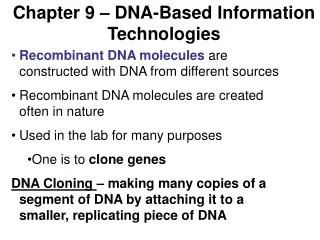
Recombinant DNA methods • Restriction enzymes • Enzymes from bacteria • Used to cut DNA molecules in specific places • Enable researchers to cut DNA into manageable segments • Vector molecule carrier of DNA fragment into cell • Transformation: uptake of foreign DNA into cells
Splicing foreign DNA into a vector • Foreign DNA and plasmid DNA cut with same restriction enzyme • Produces linear molecules with complementary single-stranded ends • Recombinant DNA created by mixing so sticky ends pair • DNA ligase forms covalent bonds, linking the two fragments
Genomic library • Collection of DNA fragments that represent all the DNA in the genome • Chromosome library • All the DNA fragments in that specific chromosome • cDNA library • Produced using reverse transcriptase • Makes DNA copies of mature mRNA
Genetic probes • Segments of single-stranded DNA that can hybridize to complementary base sequences in target gene • Southern blot technique
Using a geneticprobe to find bacterial cellswith a specificrecombinant DNA molecule
Amplifying DNA in vitro by PCR • Small amount of double-stranded DNA • DNA precursors • Specific nucleic acid primers • Taq DNA polymerase • DNA is denatured • Primers attach to primer-binding site on each DNA strand • Each strand acts as template for DNA synthesis
DNA sequencing • Based on chain termination method • Yields information about • Structure of gene • Probable amino acid sequences of its encoded proteins
Applications of DNA technology • Gene therapy • Tissue engineering • DNA typing
Transgenic organisms • Foreign DNA incorporated into their genetic material • Gene target • Single gene inactivated or “knocked out” • “Knockout mice” used in studying genes • Mutagenesis screening • Male mice treated with mutagens and studied
A transgenicmouse Mouse on rightis normal; mouseon left is transgenic animal expressing rat growth hormone
Transgenicrice “Golden rice”shown intermixedwith white ricecontain highconcentrationsof beta-carotene
Safety guidelines • Safety concerns • Introduction of transgenic organisms into the environment • Health effects on humans from consuming GM crops • Safety measures • Special facilities designed to hold pathogenic organisms • Science of risk assessment