Enabling Neuroinformatics Collaboration and Resource Sharing via NITRC
NITRC serves as the premier collaboration environment for neuroinformatics, facilitating the distribution, enhancement, and adoption of key neuroimaging resources, including MR, CT, PET/SPECT, and EEG/MEG. It features a curated repository of DICOM and NIfTI-1 images, searchable by various metadata. Researchers can easily access cloud-based tools for data processing, saving time and resources. NITRC supports academics and students alike in exploring neuroimaging solutions, while promoting reproducible science through community engagement and robust data sharing.

Enabling Neuroinformatics Collaboration and Resource Sharing via NITRC
E N D
Presentation Transcript
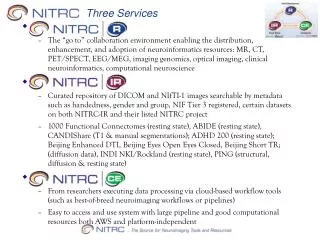
Three Services • X • The “go to” collaboration environment enabling the distribution, enhancement, and adoption of neuroinformatics resources: MR, CT, PET/SPECT, EEG/MEG, imaging genomics, optical imaging, clinical neuroinformatics, computational neuroscience • X • Curated repository of DICOM and NIfTI-1 images searchable by metadata such as handedness, gender and group, NIF Tier 3 registered, certain datasets on both NITRC-IR and their listed NITRC project • 1000 Functional Connectomes (resting state), ABIDE (resting state), CANDIShare (T1 & manual segmentations); ADHD 200 (resting state); Beijing Enhanced DTI, Beijing Eyes Open Eyes Closed, Beijing Short TR; (diffusion data), INDI NKI/Rockland (resting state), PING (structural, diffusion & resting state) • X • From researchers executing data processing via cloud-based workflow tools (such as best-of-breed neuroimaging workflows or pipelines) • Easy to access and use system with large pipeline and good computational resources both AWS and platform-independent
Impact on End Users • Faculty • Use NITRC to point to software and data (theirs as well as others’) for their courses • Students (and others new to the field) • Use NITRC’s community forums and other resources to get a feel for the neuroimaging community as a whole • Can study pros and cons of multiple existing potential solutions • Easy access to existing solutions • Experienced Users • Optimize processing options by upgrading techniques and mixing and matching methods • Sample Testimonial (see information packet for complete list) • [NITRC] has greatly reduced the cost of managing [our] software development, and it has been an incredible resource for sharing resources with collaborators around the world.
Impact on Neuroscience Research • Accelerating Scientific Progress • NITRC has become the first choice for neuroscience researchers to find neuroimaging tools and share data and resources (1000 functional connectomes) • Labs spend less time searching for and developing lab-specific software • Universities rely on NITRC’s services, storage, and uptime • Time and resources are redirected towards basic research • Optimizing Techniques • Mixing and matching best-of-breed tools promotes maximum power to detect biological signals • Promoting Reproducible Science • Community access to data and tools • Independent confirmation and strengthened impact of results • NIH and Other Neuroscience Initiative Interoperability • NIF, Biositemaps, and INCF
More Data, More Downloads, More Citations • 9 studies totaling 4,700 images • Studies include: 1000 Connectomes, Neurobureau, ABIDE, CANDI Share, Multi-Modal MRI, PING, INDI NKI/Rockland, ADHD-200, and Beijing Enhanced, Eyes Open Eyes Closed, and Short TR
New Cloud Compute Service • Current: AWS Marketplace or own infrastructure • Planned: Microsoft VMDepot, adding additional neuroimaging packages • Becoming an essential service for NDAR data processing
Selected Testimonials (more on site) • Saves Valuable Research Time • Researchers saved time searching the Internet or developing redundant tools by finding the right neuroimaging tools on NITRC due to its search structure, meta-tags, ratings and reviews, and developer contact database • Useful for Research • Researchers found neuroimaging tools on NITRC for use in their research and have published as a result • Saves Infrastructure Funds • By using NITRC infrastructure for tool development, collaboration, or distribution, lab chiefs save money and time, thus redirect those finite resources to research • the NITRC community collaborates internationally and across university and institute lines
Home Page 1/14/2014
Browse 1/14/2014 Page 10
Additional Browsing 1/14/2014
Compare 1/14/2014
Standardized Resource Description 1/14/2014
Community 1/14/2014 Page 14
Data Resources 1/14/2014 Page 15
Data Resources NITRC Project Webpage NITRC Project Homepage 1/14/2014 Page 16
Data Resources 1/14/2014
Data Workflow NITRC Project -> IR Project -> Subjects -> Subject -> Images
Search: Sample Filter (M/F LIKE M) AND ((Age >= 40) AND (Age <= 50)) AND (Project LIKE fcon_1000))
Log In Page 23
Logged In Page 24
Start Page 25
Configure StarCluster Python installer Runs on any local environment (Mac, Linux, Windows)
Starting a Cluster • Simple command line interface well documented • http://star.mit.edu/cluster/docs/latest/index.html
StarCluster: Two Amazon EC2 Instances • Verify Starcluster working via the AWS console
Cluster Running • StarCluster at work! • Next task to add neuroimaging software applications
Installer Script Allow Independent Platform Choices • Plain Vanilla VMWare Ubuntu 12.04 (i.e., preparing to run our script) • VMware Player
Example: FSL‘Bedpostx’ Bayesian Estimation of Diffusion Parameters Obtained using Sampling Techniques. Runs Markov Chain Monte Carlo sampling to build up distributions on diffusion parameters at each voxel necessary for running probabilistic tractography. • Data: DTI, 2.5mm3 spatial resolution, 32 diffusion directions, b=1000, 60 axial slices, acquisition time 6 min), TR = 9s, TE = 35ms • Parallelization: FSL automatically distributes ‘bedpostx’ into “per slice” jobs and queues them to the SGE. (60 jobs in this case)
Sample Performance Data FSL ‘bedpostx’ example - Processing Time: 5 hours 54 minutes (354 minutes) on 1 core desktop Mac… m1.small, 1 Core, 2 EC2-PU $0.06/hour, 450 min, $2.00 cc2.8xlarge, 16 Cores, 88 EC2-PU $3.06/hour, 20 min, $3.06
Costand Processing Time Freesurfer • Data: ABIDE MPRAGE subjects • Parallelization: None per subject, but can run a subject per instance/core for simultaneous execution on a population FSL ‘VBM’ • Data: 103 subjects T1 • Parallelization: FSL will automatically parse the template registration steps into ‘per subject’ jobs and submit to SGE • Processing Time: • m1.8xlarge (8 cores) • Cost: $20.00
StarCluster and GridEngine at Work • Job submission • Watching the jobs run