SECONDARY MARKET RESEARCH
390 likes | 530 Vues
This guide explores the essentials of secondary market research, highlighting the importance of existing information from various sources. Secondary research utilizes data compiled by others or from internal records, offering cost-effective and quick access to insights about consumers, firms, and industries. Key resources include trade journals, business publications, government documents, and databases. While secondary research may lack specificity or currency, it remains invaluable for preliminary insights and industry understanding. Practical tips for effective searching within databases such as Lexis-Nexis and the significance of NAICS codes are also discussed.


SECONDARY MARKET RESEARCH
E N D
Presentation Transcript
SECONDARY MARKET RESEARCH FINDING INFORMATION ABOUT CONSUMERS, FIRMS, INDUSTRIES, AND ENVIRONMENT
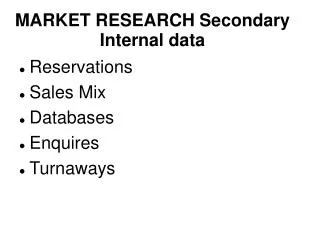
Market Research • Two types of market research • Secondary: Use of existing information compiled by someone else or generated from internal records (e.g., billing statements, shipping records) • Primary research: Research performed expressly to obtain information on customers and markets (e.g., surveys, experiments, focus groups) • Secondary sources may not have sufficiently current and/or specific information. However, when these sources are available: • Costs are usually much lower • Information can be accessed much quickly
Some sources of secondary data: • Internal records/information system • Trade journals, magazines, and newspapers • Each industry usually has one or more trade journals—publications dealing with issues specific to this industry (e.g., Women’s Wear Daily, Air Cargo World, Ice Cream Reporter) • General business publications—e.g., Wall Street Journal, Business Week, Financial Times • General newspapers and magazines may address relevant issues • Reviews in consumer magazines of relevant product categories • Government documents • Compilations/reports (e.g., Economist Intelligence Unit reports on specific countries) • Other data bases (e.g., Hoover’s, Business & Company Resource Center)
AND: Both conditions have to be true ICE CREAM AND CARBOHYDRATE
OR: One or both conditions must be true DESSERT OR SNACK
AND NOT: The first but NOT the second condition must be true PRICING AND NOT FINANCE
The Search Form Note: In specifying searches, less is often more. You should avoid extraneous words that may have synonyms.
Other Search Types • Location (country or region) • Product name (but not company name) • NAICS code (see below) • Person name (e.g., the name of a company CEO)
“Snow Balling”: Using article records to find additional relevant articles
Industry Information: NAICS codes • Taxonomy of North American industry structure • Technically only for U.S., Canada, and Mexico but used internationally • Hierarchical structure—the more digits, the more specific the industry • Each six digit code may still cover a very wide range of products/services
Finding NAICS codes on the U.S. Census Bureau Web Site This site is usually the first one that will show up if you Google the term “NAICS.”
Business Insights: EssentialsSample Listing for NAICS 325620
Finding Books • The USC Libraries have the HOMER database of books • However, Amazon.com may provide a more useful list: • Collaborative filtering: Comparison to what others who bought particular books bought • Expanded search algorithms to identify related topics • In the second phase, HOMER can help retrieve those books we have in stock
Currency of Information • Information on some topics becomes obsolete more quickly than others—e.g., • China, Russia, India, Thailand • Internet, IT • Oil, airlines (highly cyclical)
Closing Words • The only way to learn these searches is actual practice • For many projects, you will need to search more broadly, possibly in related industries