Download
1 / 1
10 likes | 150 Vues
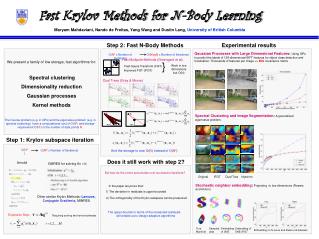
This research explores advanced N-body learning techniques and Gaussian processes (GPs) for high-dimensional feature detection and object localization. Key methods discussed include Spectral Clustering and improved Fast Gauss Transform (IFGT) for effective dimensionality reduction. The paper focuses on Krylov subspace methods, demonstrating their computational efficiency and lower storage requirements. We present experimental results using SIFT features for object class detection, showcasing algorithms' accuracy in managing large datasets while maintaining manageable computational costs.

E N D
xi xi Xj’s Xj’s O(N2 x Number of Iterations) O(NlogN x Number of Iterations) O(N3 ) O(N2 x Number of Iterations) True Manifold Sampled data Embedding of SNE Embedding of SNE+IFGT Fast Krylov Methods for N-Body Learning Maryam Mahdaviani, Nando de Freitas, Yang Wang and Dustin Lang, University of British Columbia Experimental results Step 2: Fast N-Body Methods Gaussian Processes with Large Dimensional Features: Using GPs to predict the labels of 128-dimensional SIFT features for object class detection and localization. Thousands of features per image => BIG covariance matrix Fast Multipole Methods (Greengard et al): We present a family of low storage, fast algorithms for: Spectral clustering Dimensionality reduction Gaussian processes Kernel methods } Work in low dimensions but O(N) Fast Gauss Transform (FGT) Improved FGT (IFGT) Dual Trees (Gray & Moore) Spectral Clustering and Image Segmentation: A generalized eigenvalue problem. The inverse problem (e.g. in GPs) and the eigenvalue problem (e.g. in spectral clustering) have a computational cost of O(N3) and storage requirement O(N2) in the number of data points N. Step 1: Krylov subspace iteration And the storage is now O(N) instead of O(N2) Does it still work with step 2? Arnoldi GMRES for solving Ax = b But how do the errors accumulate over successive iterations? Original IFGT Dual Tree Nystrom Stochastic neighbor embedding: Projecting to low dimensions (Roweis and Hinton) In the paper we prove that: • The deviation in residuals is upper bounded Other similar Krylov Methods: Lanczos, Conjugate Gradients, MINRES 2) The orthogonality of the Krylov subspace can be preserved The upper-bounds in terms of the measured residuals will enable us to design adaptive algorithms Expensive Step: Requiring solving two kernel estimates Embedding on S-curve and Swiss-roll datasets