Download
1 / 31
310 likes | 451 Vues
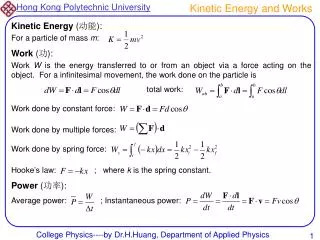
This review covers essential concepts of kinetic energy, work, and power in physics, including key formulas and calculations. Students will learn about the kinetic energy formula, units of energy and work, and the differences between scalar and vector quantities. The review also explores mechanical advantage, efficiency of machines, and conservative forces. Homework assignments and questions will prepare students for upcoming tests on these topics. Understanding these fundamentals is crucial for grasping energy transfer and mechanics.

E N D
Tue Jan 31 Today Reviewhw 5.5 Read p293-295 (p280) 83,87,91 (p307-9) 56, 61,76,81,82ch 10-11 test next Tue. or Wed.!
The formula for kinetic energy is: • K=(mv2)/2 • K=(mv)2/2 • K=2mv2 • K=(mg)/h 0 of 30
The SI units for energy and work are: • Newtons • Watts • Joules • Amperes 0 of 30
Kinetic energy is a ____ quantity • Tensor • Scalar • Vector • Negative 0 of 30
The transfer of energy by mechanical means is called _______. • Heat • Machination • Work • Force 0 of 30
Work is done when: • A force acts through a distance. • A hot object touches a cold object. • A force acts perpendicular to a displacement • You sleep on the job. 0 of 30
Energy stored in an object that has been lifted in a gravitational field is called: • Elastic potential energy • Gravitational potential energy • Chemical potential energy. • Thermal energy. 0 of 30
If an object’s speed doubles its kinetic energy: • Quadruples • Doubles • Is cut in half. • Doesn’t change 0 of 30
The kinetic energy of a 4.0 kg object moving at 3.0 m/s is: • 12 J • 18 J • 36 J • 48 J 0 of 30
How much work is done if you push a 5.0 kg box 12 meters across the floor while applying a 10.0 N force? • 50 J • 60 J • 120 J • 600 J 0 of 30
How much work do you do if you lift a 6.0 kg object 50 cm up? • None • 3.0 J • 30 J • 3.0 kJ 0 of 30
_____ describes how quickly energy is transferred. • Kinetic energy • Velocity • Power • Pressure 0 of 30
The SI units of power are: • Joules • Teslas • Pascals • Watts 0 of 30
A Watt is equal to • N m • J s • N/m2 • J/s 0 of 30
I have 1.2 kW microwave. How much electrical energy is converted if I heat something on high for 30 seconds? • 40 J • 400 J • 600 J • 36 kJ 0 of 30
If the power output of a motor is 65 W, how long does it take to do 195 J of work? • 1.95 seconds • 3.0 seconds • 260 seconds • 3.5 hours 0 of 30
________ is where we decide to set gravitational potential energy to zero. • The null zone • Outer space • The reference level • On top of spaghetti 0 of 30
Which of the following is a conservative force? • Friction • Thrust • Gravity • Air resistance 0 of 30
A 4.0 kg object is moving has 72 J of kinetic energy when it is 3.0 m above the reference level. Its speed is • 2.0 m/s • 5.0 m/s • 6.0 m/s • 192 m/s 0 of 30
A 4.0 kg object has 72 J of kinetic energy when it is 3.0 m above the reference level. Its total mechanical energy is • 0.0 J • 72 J • 120 J • 192 J 0 of 30
A 4.0 kg object has 72 J of kinetic energy when it is 3.0 m above the reference level. Once it falls down to the reference level it will have a kinetic energy of • 72 J • 120 J • 192 J • 0.0 J 0 of 30
Simple machines can NOT • Multiply the force that is exerted • Multiply the work that is done • Change the direction a force is exerted • Change the speed 0 of 30
The mechanical advantage of a simple machine describes • How much the machine multiplies the work you do • How much the distance is multiplied • How much the force is multiplied • How much the power is multiplied 0 of 30
The efficiency of a machine describes: • The ratio of the output work to the input work • The ratio of the output force to the input force • The ratio of the output distance to the input distance 0 of 30
If a machine has a mechanical advantage of 5.0 how much force must you exert to lift a 60 kg object? • 60 N • 120 N • 300 N • 3.0 kN 0 of 30
An input of 8.0 kJ of work is is provided to a machine that exerts a 2.0 kN force through a distance of 3.0 meters. What is the efficiency? • 25% • 37.5 % • 75% • 133% 0 of 30
A pulley is used to raise a 2.0 kg object 50 cm off of the table. The work done BY the machine is: • 1.0 kJ • 100 J • 10.0 J • 1.0 J 0 of 30
A pulley is used to raise a 2.0 kg object 50 cm off of the table. The person pulling the string exerts a force of 8.0 N through a distance of 2.0 m. How much work is done by the person? • 1.0 J • 10.0 J • 4.0 J • 16 J 0 of 30
A pulley is used to raise a 2.0 kg object 50 cm off of the table. The person pulling the string exerts a force of 8.0 N through a distance of 2.0 m. The mechanical advantage of the machine is • 4.0 • 2.5 • 2.0 • 0.50 0 of 30
A pulley is used to raise a 2.0 kg object 50 cm off of the table. The person pulling the string exerts a force of 8.0 N through a distance of 2.0 m. The efficiency of the machine is • 31% • 63% • 100% • 160% 0 of 30
A pulley is used to raise a 2.0 kg object 50 cm off of the table. The person pulling the string moves their hand 2.0 m. What is the IMA of the machine? • 4.0 • 2.5 • 0.25 • 10.0 0 of 30