Download
1 / 10
100 likes | 227 Vues
This text explores the unique properties of various materials and their appropriate uses. It highlights the characteristics of elastic, rigid, and flexible materials, illustrating their application in items like asphalt for roads and glass for windows. The descriptions also cover the requirements for specific products, such as buoyancy for floats, durability for cots, and absorbency for sponges. Each material is chosen based on its functional qualities, ensuring suitability for its intended purpose, from lightweight parachutes to waterproof umbrellas.

E N D
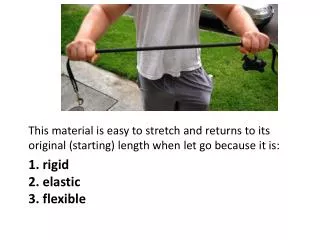
This material is easy to stretch and returns to its original (starting) length when let go because it is: 1. rigid2. elastic3. flexible
The material asphalt is used to build roads. It needs to be: 1. fragile2. flimsy3. durable
Glass breaks easily because it is: 1. transparent2. fragile3. flexible
This float is being used to mark some dangerous rocks below the water. It needs to be made of a material which is: 1. bendy2. opaque3. buoyant
This cot is made of a very rigid material. This means it: 1. will not catch fire easily2. will not bend easily3. is easy to clean
Gljksjdhasdjksahdkasdjask Glass is used for windows because it is:1. translucent2. transparent3. opaque
This flexible ruler is probably made of: 1. iron ( a type of metal)2. glass3. rubber
The material for this parachute needs to be:1. lightweight and transparent2. strong and colourful3. strong and lightweight
Sponges are very absorbent. This means that they:1. do not change shape when they are wet2. can take in and hold a lot of water3. are waterproof
The material for an umbrella should be:1. absorbent and durable2. absorbent and heavy3. waterproof and light