Download
1 / 3
30 likes | 237 Vues
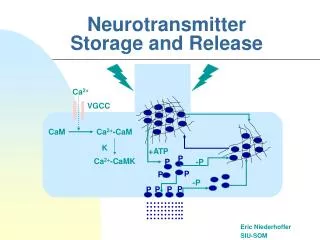
This review explores the intricate mechanisms underlying neurotransmitter storage and release, focusing on the roles of calcium ions (Ca2+), calmodulin (CaM), and calcium/calmodulin-dependent protein kinases (CaMK). We examine the complexities of synaptic vesicle docking and fusion, highlighting key proteins such as v-SNAREs, t-SNAREs, and the impact of toxins like botulinum and tetanus on neurotransmission. Key questions discussed include how neurotransmitters are packaged and released, alongside their signal transduction pathways, receptors, and transport systems.

E N D
VGCC CaM K +ATP P P Ca2+-CaMK -P P P -P P P P P Neurotransmitter Storage and Release Eric Niederhoffer SIU-SOM Ca2+ Ca2+-CaM ……….. ……….. ……….. ……….. ………..
……….. ……….. ……….. ……….. ……….. NT Botulinum and Tetanus toxin Storage and release complex Docking and fusion complex Synp Synt Synb VAMP SNAP 23 25 Synx Nr Ca2+ Vesicle Fusion VT Ac Syn CaMK v-SNARE Rab3 t-SNARE
Review Questions • How are neurotransmitters packaged and released (signal transduction pathway, second messenger, transporters, receptors)?