Understanding Photosynthesis: The Light Reactions and the Calvin Cycle Explained
This comprehensive overview of photosynthesis explores how plants convert light energy into chemical energy. It delves into the two main stages: the light reactions, where sunlight is captured to produce ATP and NADPH, and the Calvin Cycle, utilizing these energy-storing compounds to convert CO2 into carbohydrates. We also examine the chloroplast structure, the role of pigments, and adaptations like C4 and CAM pathways that enhance efficiency under varying environmental conditions. Perfect for students and biology enthusiasts alike!

Understanding Photosynthesis: The Light Reactions and the Calvin Cycle Explained
E N D
Presentation Transcript
PHOTOSYNTHESIS Chapter 6
Photosynthesis Capturing the energy in Light The Calvin Cycle
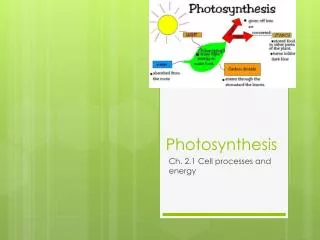
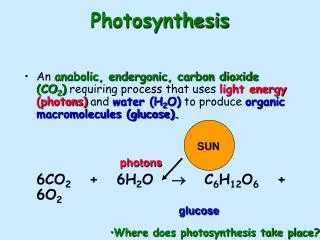
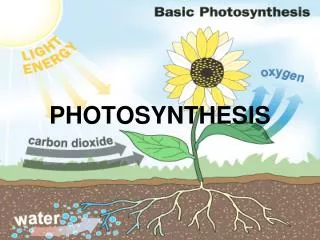
Photosynthesis: Big Picture • Energy Transfer: • Light organic compound (food) • Overall: 6CO2 + 6H2O + sunlight C6H12O6 + 6O2 • Biochemical Pathway: • product of one rxn consumed in 2nd rxn • 2 steps: • Light reactions: • Light ATP + NADPH (energy-storing compounds) • Calvin Cycle= Dark Reactions • CO2 + ATP + NADPH carbohydrate + ADP + NADP+
Autotroph: manufacturer their own food • Heterotrophs: eat autotrophs or heterotrophs • Energy for Life Processes
Light & Light Absorption in Plants • White Sunlight • Visible spectrum: ROY G. BIV • Travels in waves • Can be transmitted, absorbed, or reflected • Pigments • Organic compound that absorbs certain colors and reflects/ transmits others • Example: Chlorophyll in chloroplasts • Chloroplast Pigments: located in thylakoid membrane • Chlorophyll a • Chlorophyll b: accessory pigment • Carotenoids: accessory pigments, reflects yellow/ orange Most abundant, Reflects green
Chloroplast Structure • Chloroplast: location for photosynthesis • 2 membranes: inner & outer • Thylakoids stacked= Grana • Stroma • Photosystems (PS I & PS II) • Located in thylakoid membrane • Cluster of pigment molecules that absorb light energy • Primary Electron Acceptor • Molecule in thylakoid membrane that accepts excited e- and passes them to electron transport chain • Electron Transport Chain (ETC) • Chain of molecules in thylakoid membrane that can release energy by carrying excited e-
Light Reaction Steps @ PS II Step 1 PS II Absorbs Light Energy in Pigment Molecules exciting the electrons (e-) in the chlorophyll a Step 2 Excited e- leave PS II (oxidation) received at primary e- acceptor (reduction) Step 3 Primary e- acceptor donates e- to 1st ETC • e- lose energy passing down the ETC • Lost energy is used to pump protons (H+) into thylakoid Step 4 These e- replace the e- lost in PS I
Light Reaction Steps @ PS I Step 1 PS I Absorbs Light Energy in Pigment Molecules exciting the e- in the chlorophyll a • These events @ PS I are happening simultaneously as PS II Step 2 Excited e- leave PS I (oxidation) received at primary e- acceptor (reduction) Step 3 Primary e- Aceptor donates e- to a 2nd ETC • e- lose energy passing down the ETC • Lost energy is used to combine e- with a proton (H+) and an e- acceptor molecule NADP+ to form NADPH in stroma
Restoring PS II • Lost e- at PS II replaced by H2O • Enzyme splits H2O • 2H2O 4H+ + 4e- + O2 Left inside thylakoid Replace PS II Diffuses out of plant
Chemiosmosis • Generates ATP • Relies onH+ conc. gradient: Creates PE • Maintained by: • Breakdown of H2O • Released energy from PS II e- transport chain pumps H+into thylakoid • ATP synthase: multifunctional protein • Channel • Enzyme
Calvin Cycle= Light Independent Rxn Carbon Fixation • CO2 organic cmpds Can’t Run Without • NADPH • ATP G3P PGAL/G3P Converted to: • Organic Compounds • RuBP start cycle
Calvin Cycle PGA G3P
Alternative Pathways • Regular Pathway: • C3 Pathway • Calvin Cycle: 3-C compound (PGA) • Alternative Pathways: adaptation to hot, dry climate • C4 Pathway • Fix Carbon into 4-C compound Calvin Cycle • Lose less H2O for same carbohydrate made • Sugar cane, corn, crabgrass • CAM Pathway • Fix Carbon into compounds at night Calvin Cycle by day • Grow slowly, but lose less H2O than C3 & C4 • Cacti, pineapples
Influences on Rate of Photosynthesis • Light Intensity Increases • Increases photosynthesis until reach plateau • CO2 Increases • Increases photosynthesis until reach plateau • Temperature Increases • Increases photosynthesis until enzymes denatured & stomata close decreases photosynthesis