Active Galactic Nuclei
This lecture explores the fascinating world of Active Galactic Nuclei (AGN), detailing the characteristics of various types such as Seyfert galaxies, radio galaxies, and quasars. We delve into their energetic cores, the significance of multiwavelength observations, and the phenomena of rapid brightness changes. The session examines black holes' role and the unified model that explains AGNs' properties based on our viewing angle. We investigate commonalities among these strange galaxies and the mechanisms driving their activity, including gravitational interactions and tidal forces.

Active Galactic Nuclei
E N D
Presentation Transcript
Active Galactic Nuclei Astronomy 315 Professor Lee Carkner Lecture 21
Strange Galaxies • Some galaxies have a compact, powerful source of energy at their core • Among the most energetic objects in the universe • Need multiwavelength observations to understand them
Seyfert Galaxies • Seyfert galaxies are spirals with optically bright, concentrated nuclei • Can change in brightness very quickly • Small, but very bright
Other Seyfert Properties • Some Seyferts have broad emission lines • These same Seyferts also are bright in high energy X-ray and UV radiation • Called Type 1 Seyferts
Seyfert Clues • Are there any common properties shared by Seyfert galaxies? • Are Seyferts caused by gravitational interactions?
Radio Galaxies • Some galaxies are flanked on either side by a pair of radio lobes • Some central galaxies are also bright radio sources and some are not
Mapping the Lobes • Radio lobes often show hot spots of enhanced emission • Lobes are material ejected from the star and impacting the intergalactic medium • Radio galaxies produce bipolar jets (like young stars)
Source of Radio Waves • Radio emission is due to synchrotron radiation • Lobes must have magnetic field and galaxy must be ejecting electrons • Total energy stored in lobes is huge
Radio Galaxy Properties • Central galaxy is often giant elliptical and in a crowded cluster • Often deformed • Jets sometimes are twisted • Some radio galaxies have broad and narrow lines, some just narrow lines
BL Lac Objects • BL Lac objects look like stars but show rapid variations • They don’t show the broad or narrow lines we see in Seyfert galaxies • Don’t have radio lobes
Quasars • Some sources of radio galaxies look like stars • Quasars have very large red shifts and very large distances • Since quasars are billions of light years away, we are seeing what they looked like billions of years ago
Quasar Properties • In most cases you can’t see the host galaxy • Core must be brighter than regular AGN • Quasars are younger than “normal” AGNs • Type 1 quasars have broad emission lines, Type 2 quasars do not
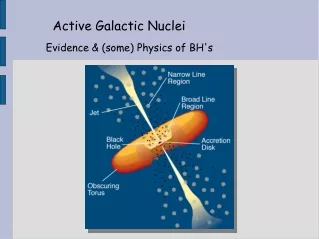
AGN Power Source • We have two questions about AGNs • Different types of AGNs are due to viewing matter falling into a black hole from different angles
Massive Black Holes • AGN black holes are a million to a billion times the mass of the Sun • Why do we think they have black holes? • Computed densities indicate black hole • AGNs vary so rapidly that the emitting region must be very small (small+massive=BH)
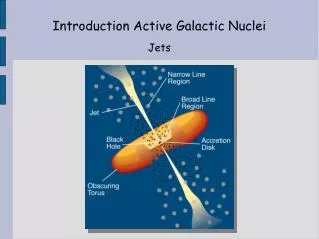
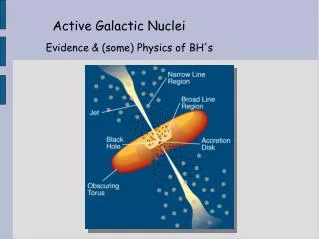
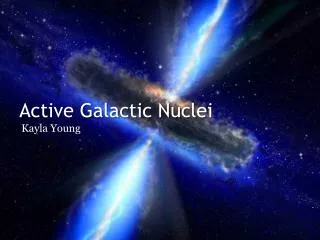
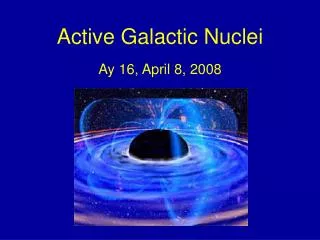
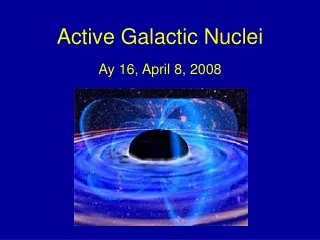
Structure of the Core • Black hole pulls matter into an accretion disk • Outer disk is thick can block view of center • The moving material twists up the magnetic field creating a magnetic flux tube that the jets follow out the poles
Unified Model • How does this model account for the basic properties of AGNs? • We thus see the jet and disk regions in different ways, producing the observed type of AGN
Case 1 -- Face on • Can see the radio jets, but no lobes • Can’t see broad or narrow lines • Type of AGN
Case 2 -- Inclined • Can see radio emission and lobes • Can also see broad and narrow lines • Types of AGN:
Case 3 -- Edge on • Can see radio emission and lobes • Only see narrow lines • Types of AGN
Quasars and AGNs • Quasars act very much like extra powerful versions of radio galaxies or BL Lac objects • Quasars may be young active AGN, low red shift active galaxies may be AGN that have been refueled
AGN and Non-AGN • Why are some galaxies active and others not? • We think all galaxies have black holes • What makes a galaxy active is matter falling into it • Collisions and tidal forces may disrupt the center of galaxies and move material into the black hole
Next Time • Read 24 .4-24.5