Understand how the Lateral Geniculate Nucleus transmits visual information and explore the efficiency of coding natural scenes. Learn about spike timing precision, spike count reliability, and bursting phenomena. Visit www-biology.ucsd.edu/labs/reinagel/ for more details.
01 / 52LGN Function and Efficient Coding in Visual Processing
1 / 17
Télécharger la présentation
LGN Function and Efficient Coding in Visual Processing
Une image / un lien ci-dessous est fourni (tel quel) pour télécharger la présentation
Politique de téléchargement : le contenu du site vous est fourni TEL QUEL pour votre information et votre usage personnel ; il ne peut être vendu, concédé sous licence ni partagé sur d’autres sites sans l’accord de son auteur.Le contenu vous est fourni TEL QUEL, pour votre information et votre usage personnel uniquement.Téléchargez la présentation en cliquant sur ce lien.Lors du téléchargement, si vous ne parvenez pas à télécharger une présentation, l’éditeur a peut-être supprimé le fichier de son serveur.Pendant le téléchargement, si vous ne parvenez pas à obtenir une présentation, le fichier a peut-être été supprimé par l’éditeur.
F I N
Plus de contenu associé
Transcription de la présentation
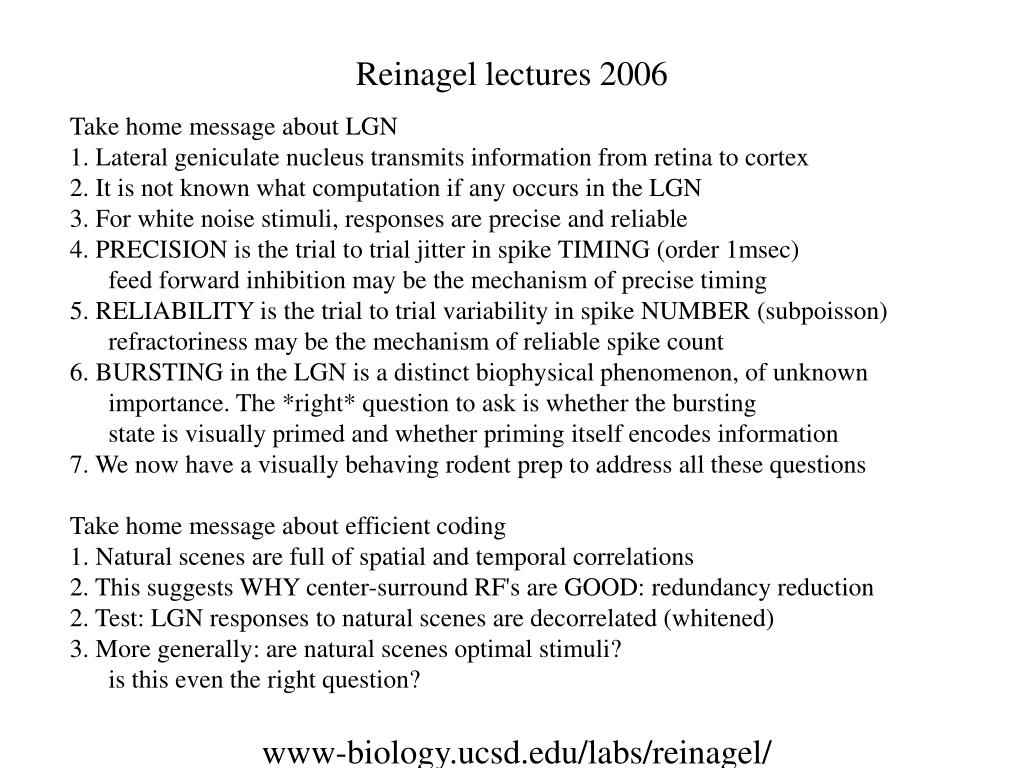
Reinagel lectures 2006 Take home message about LGN 1. Lateral geniculate nucleus transmits information from retina to cortex 2. It is not known what computation if any occurs in the LGN 3. For white noise stimuli, responses are precise and reliable 4. PRECISION is the trial to trial jitter in spike TIMING (order 1msec) feed forward inhibition may be the mechanism of precise timing 5. RELIABILITY is the trial to trial variability in spike NUMBER (subpoisson) refractoriness may be the mechanism of reliable spike count 6. BURSTING in the LGN is a distinct biophysical phenomenon, of unknown importance. The *right* question to ask is whether the bursting state is visually primed and whether priming itself encodes information 7. We now have a visually behaving rodent prep to address all these questions Take home message about efficient coding 1. Natural scenes are full of spatial and temporal correlations 2. This suggests WHY center-surround RF's are GOOD: redundancy reduction 2. Test: LGN responses to natural scenes are decorrelated (whitened) 3. More generally: are natural scenes optimal stimuli? is this even the right question? www-biology.ucsd.edu/labs/reinagel/
Lateral Geniculate Nucleus Hubel 1960 (alert cat) Hubel & Wiesel 1961 (anesthetized) Retina LGN Cortex Ramon y Cajal
What happens in the LGN? • spiking inputs • intrinsic properties • local circuits • cortical feedback Gating? Attention? Binding? Prediction testing? Nothing?
LGN response to purely temporal stimuli Luminance Repeat • Descriptive questions: • how precise is the timing? • how reliable is the number? • are there internal patterns? • In each case: • visual information? • mechanism of encoding? • mechanism of decoding? Reinagel & Reid, 2000
Temporal precision of visual information a b c d e 100 Mutual Information (bits/s) 50 0 0.5 1 2 4 8 16 32 64 128 Precision of spike times used (ms) Theory of Shannon, 1948 Method of Strong et al., 1998 Result of Reinagel & Reid, 2000
V1 RGC Refractoriness decreasesfrom retina to cortex 1.0 0.5 Recovery Function 0.0 0 10 20 30 Time (ms) Kara, Reinagel & Reid, 2000
Summary of Reliability • Spike count has sub-Poisson variability • High FR High Reliability • Refractoriness completely explains • Noise is low, but doubling each synapse • firing rate is decreasing • refractoriness is decreasing
Bursting in the LGN • not rhythmic or synchronous in anesthetized animals • visual in anesthetized animals • synapses prefer bursts • do occur in alert animals, and rare signals can be important • cool computational ideas • ERGO • Bursts are crucial to vision • dominate during sleep, when vision is suppressed • frequent under anesthesia, when vision is absent • almost never seen in alert animals, when vision is happening • ERGO • Bursts are irrelevant to vision
Optimal Guess of Stimulus Before a burst Before a tonic spike 0.2 0.1 1.5 0.2 0 0.15 -0.1 1 Coding Efficiency Bits/event -0.6 -0.4 -0.2 0 0.1 Time before spike (s) 0.5 0.05 0 0 Burst Tonic Burst Tonic Visual inputs trigger bursts Reinagel, Godwin, Sherman & Koch 1999
Trigger synaptic input • • • • • • • • Bursts: Triggering vs. Priming AP times observable Ca++ spike * active inactive LT-Ca++ channel state time
Denning & Reinagel 2005 Alitto, Weyand & Usrey 2005 Lesica & Stanley 2004 Bursts in LGN are distinct code words
Summary: Bursting • • LGN neurons have 2 states • • Visual inputs trigger responses in both states • • Visual inputs also control the state • BUT All this is under anesthesia • What about alert? • - Stimulus ensemble matters • Behavioral state may also • Triggering and priming
What happens in the LGN? • spiking inputs • intrinsic properties • local circuits • cortical feedback
Directions • Do bursts occur and are they visual in alert animals? • Function of cortical feedback to the LGN? • Does precision in the LGN matter for perception?