Download
1 / 13
160 likes | 643 Vues
Dr. Stephen R. Covey, born on October 24, 1932, in Salt Lake City, Utah, authored over 20 million books in 38 languages, including the iconic "The 7 Habits of Highly Effective People." A professor at Utah State University and co-founder of Franklin-Covey, he dedicated his life to empowering individuals to take control of their destinies. Recognized as a leading voice in personal development and organizational consulting, Covey's teachings on proactivity, effective communication, and finding one's voice continue to inspire millions worldwide.

E N D
Dr. Stephen R. Covey ED 530 Theorist Presentation Summer 2010 Hilary Prego
Background Information • Born October 24, 1932 in Salt Lake City, Utah • Written and sold over 20 million books in 38 languages • Professor at the Jon M. Huntsman School of Business at Utah State University • Served as the first president of the Irish Mission of the Church starting in July 1962 Image Source
Background Information • Board of directors for the Points of Light Foundations • Co-founder and vice chairman of Franklin-Covey organization • Dedicated his life to showing people how they can truly control their destiny • Internationally respected leader, family expert, teacher, organizational consultant, and author Image Source
Education • Holds a B.S. degree in Business Administration from the University of Utah • Holds a M.B.A. degree from Harvard University • Holds a Doctor of Religious Education (DRE) in LDS (The Church of Jesus Christ of Latter-day Saints) church history from Brigham Young University • Holds a membership of the Pi Kappa Alpha International Fraternity Image Source
Milestones • Launched the Stephen Covey’s Online Community in March 2008 • The 7 Habits of Highly Effective People was named the #1 Most Influential Business Book of the Twentieth Century • Authored four books with sales exceeding one million copies each • Latest book, The 8th Habit, has sold nearly 400,000 copies Image Source
Awards and Honors • Recognized as one of Time Magazine’s 25 most influential Americans • International Entrepreneur of the Year Award • Awarded eight honorary doctorate degrees • Earned National Fatherhood Award in 2003 • International Man of Peace Award in • Received Thomas More College Medallion for continuing service to humanity
Seven Habits of Highly Effective People • Habit 1: Be Proactive • Focus on the things you can actually do something about • Habit 2: Begin with the End in Mind • Begin everything you do with a clear picture of your ultimate goal • Habit 3: Put Things First • Manage your life according to your needs and priorities • Habit 4: Think Win-Win • Integrity: Stick with your true feelings, values, and commitments • Maturity: Be considerate of the feelings of others • Abundance Mentality: Believe there is plenty for everyone Image Source
Seven Habits of Highly Effective People • Habit 5: Seek First to Understand, Then to Be Understood • Learn how to communicate clearly and listen to others • Habit 6: Synergize • “Two heads are better than one.” • Habit 7: Sharpen the Saw • Allow yourself to grow by maintaining a balanced program in the four areas of your life: physical, social/emotional, mental, and spiritual. Image Source
The Seven Habits of Highly Effective People Image Source
The Seven Habits of Highly Effective People Image Source
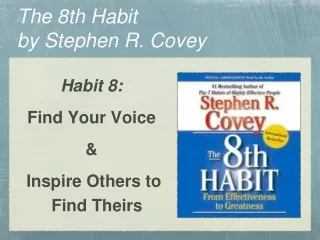
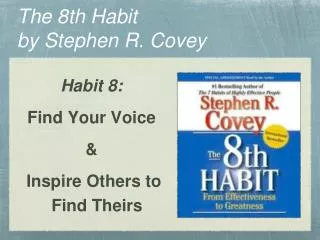
The 8th Habit: From Effectiveness to Greatness • Published in 2004 as a sequel to the 7 Habits of Highly Effective People • Essentially urges people to find their voice and inspire others to find theirs • "Voice is unique personal significance—significance that is revealed as we face our greatest challenges and that makes us equal to them.« • Dr. Stephen R. Covey, from The 8th Habit: From Effectiveness to Greatness • "People who do not live by their conscience will not experience this internal integrity and peace of mind.« • Dr. Stephen R. Covey, from The 8th Habit: From Effectiveness to Greatness Image Source
Quotations by Stephen Covey • “Actually I did not invent the seven habits, they are universal principles and most of what I wrote about is just common sense. I am embarrassed when people talk about the Covey Habits, and dislike the idea of being some sort of guru.” • “Every human has four endowments- self awareness, conscience, independent will and creative imagination. These give us the ultimate human freedom... The power to choose, to respond, to change.” • “Most people struggle with life balance simply because they haven't paid the price to decide what is really important to them.” • “We are not animals. We are not a product of what has happened to us in our past. We have the power of choice.”
References Dr. Stephen R. Covey. Retrieved May 20, 2010 from https://www.stephencovey.com/. Stephen Covey Bio. Retrieved May 20, 2010 from http://www.stephencovey.net/. Stephen R. Covey Biography. Retrieved May 20, 2010 from http://www.whitedovebooks.co.uk/7-habits/stephen-covey.html.






![[PDF] Free Download The 7 Habits of Highly Effective People By Stephen R. Covey](https://cdn4.slideserve.com/8462942/slide1-dt.jpg)
![[PDF] Free Download The 7 Habits of Highly Effective People By Stephen R. Covey](https://cdn4.slideserve.com/8463710/slide1-dt.jpg)