Molecular (Covalent) Bonding
This chapter delves into molecular (covalent) bonding in chemistry, focusing on the sharing of electrons. Key topics include single (H2), double (O2), and triple (N2) bonds, along with the concepts of bond pairs versus lone pairs. We explore Lewis dot structures for molecules like HCCH, PCl3, HCN, and OH-. The coordinate covalent bond, bond dissociation energy, and geometry of molecules (e.g., CO2, CH4, NH3, H2O, BF3) are also covered. The chapter addresses bond polarity, molecular resonance, exceptions to the octet rule, and the properties of diamagnetic and paramagnetic substances.

Molecular (Covalent) Bonding
E N D
Presentation Transcript
Molecular (Covalent) Bonding Chemistry Level ___ Chapter ____
Covalent Bond = Share Electrons • H2 single bond “shared pair” • O2 double bond bond pairs vs. lone pairs • N2 triple bond • (diatomic elements)
Lewis Dot Structures: • HCCH • PCl3 • HCN • OH-1
Coordinate covalent bond = one atom donates both electrons for the bond pair • H+1 + NH3 → • Bond dissociation energy = energy required to break bond • − < = < ≡ • Bond length • − > = > ≡
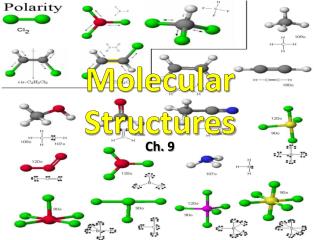
Shapes: • CO2 linear 180° • CH4 tetrahedral 109.5° • NH3 pyramidal 107° • H2O bent 105° • BF3trigonal planar120°
Polarity: • Bonds HCl H2O • Molecules CO2 H2O • Electronegativity differences indicate polarity: • Nonpolar covalent, Polar covalent, Ionic
Resonance: • O3 (ozone)
Exceptions to the Octet Rule: • Odd # of electrons • NO2 • Less than 8 • BF3 • Expanded Octet: More than 8 • SF6
Diamagnetic • All electrons are paired • Repelled by magnetic field • Paramagnetic • Has an unpaired electron • Attracted to magnetic field
Quiz Review: • Electron dot structures for a molecule • Shape • Bond angle • Polar? • Resonance? • Polar/nonpolar/ionic • Electronegativity difference • Bond dissociation energy