Molecular Compounds
This article explains molecular compounds and covalent bonds, which form when two or more atoms share electrons. The force of attraction between the atoms arises from the shared electron pairs. Key examples include methane (CH4) and ammonia (NH3). Molecular compounds, typically formed from non-metals, exhibit properties such as lower melting and boiling points compared to ionic compounds, and they generally do not conduct electricity in water. Additionally, the nomenclature rules for naming molecular compounds are outlined, including the use of prefixes to denote the number of atoms.

Molecular Compounds
E N D
Presentation Transcript
Molecular Compounds Covalent Bonds
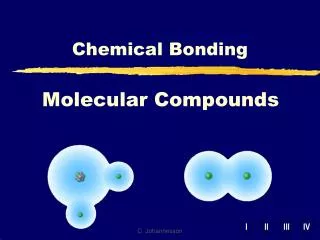
A molecule is a combination of two or more atoms held together by covalent bonds. • Covalent Bond: force of attraction between atoms that share 1, 2, 3 pairs of electrons • The electrons belong to both atoms and the attraction of the atoms for the same electron pair holds them together.
Examples • Methane, CH4 • Ammonia, NH3 • Chlorine Gas Cl2
Molecular Compounds • formed by non-metal with non-metal • share electrons to fill valence shell • The nuclei of two different atoms are attracting the same electrons. • combine in a ratio to make stable atoms
Properties • Molecular (covalent) substances: • generally have much lower melting and boiling points than ionic compounds. • are soft and squishy (compared to ionic compounds, anyway). • don't conduct electricity in water. • aren't usually very soluble in water.
Diatomics • A molecular element is two or more atoms, all of the same element, joined by covalent bonds • A diatomic molecule is a molecule that is made from two atoms
Nomenclature • Name the element furthest to the left first • Change the ending of the second non-metal to –ide • Use a prefix to specify the number of each element present
Examples • N2O PBr3 NF3 N2O2 • Dihydrogen monoxide • Phosphorous pentachloride • Carbon tetrahydride
Summary • Formed by non-metal with non-metal • Share electrons to fill valence shell • Nuclei of two different atoms are attracting the same electrons