Molecular Compounds
In this lesson, we will explore the fascinating world of molecular compounds, focusing on their nomenclature and how to write chemical formulas. You'll learn to differentiate between ionic and molecular compounds, identify molecular and diatomic compounds, and practice naming various molecular compounds. Key examples include water (H2O), ammonia (NH3), and the use of prefixes in naming, such as "di-" for two and "tetra-" for four. By the end of the class, you'll be equipped to tackle common molecular nomenclature challenges with confidence.

Molecular Compounds
E N D
Presentation Transcript
Warm Up – Mixed Nomenclature Name or write the formula: • BaO • Potassium chloride • CuBr2 • Magnesium Nitrate • Ca3(PO4)2
Warm Up – Mixed Nomenclature Write the formula for these compounds: • Iron(II) phosphite • Copper(I) carbonate • Titanium(IV) nitrate • Ammonium chloride
Learning Goals • By the end of class, I will be able to: • Differentiate between ionic and molecular compounds • Identify molecular and diatomic compounds • Name and write the formula for molecular compounds
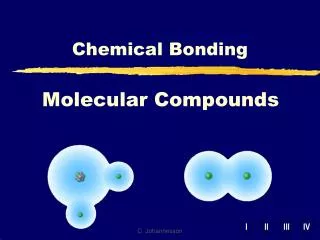
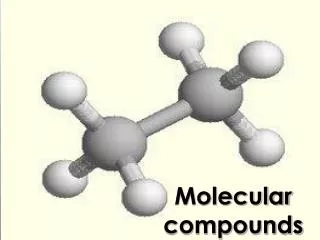
Molecular Compounds • A molecule is a combination of 2 or more atoms held together by covalent bonds • A diatomic molecule is a molecule made from 2 atoms • Common names of some molecular compounds: • Water – H2O • Ozone – O3 • Ammonia – NH3 • Methane – CH4
Examples: • P2O3 • CS2
Writing Molecular Compounds Cl F C S “di” 2 “deca” 10 “tetra” 4 S2F10 CCl4
Examples: • Carbon Tetrafluoride • DinitrogenTetraoxide
Practice • Practice problems page 168 #1-4 and #1-4 • Page 171 #12-13