Understanding Prime and Composite Numbers: Factorization, Divisibility, and Operations
This educational content delves into the concepts of prime and composite numbers, providing clear definitions and examples. It covers prime factorization, the rules of divisibility for numbers like 2 and 6, and outlines how to find factors. Additionally, it explains the order of operations (PEMDAS) for evaluating mathematical expressions. Learn how to express numbers as products of prime factors, and practice identifying whether various numbers are prime, composite, or neither. Ideal for students seeking clarity in fundamental math concepts.

Understanding Prime and Composite Numbers: Factorization, Divisibility, and Operations
E N D
Presentation Transcript
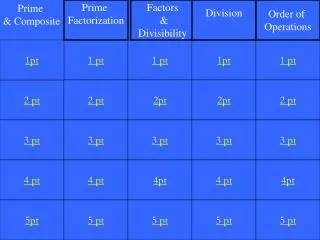
Prime & Composite Prime Factorization Factors & Divisibility Division Order of Operations 1pt 1 pt 1 pt 1pt 1 pt 2 pt 2 pt 2pt 2pt 2 pt 3 pt 3 pt 3 pt 3 pt 3 pt 4 pt 4 pt 4pt 4 pt 4pt 5pt 5 pt 5 pt 5 pt 5 pt
What is the number 30?
What is 2x3x3?
What is a number is divisible by 6 if it is divisible by both 2 and 3?
Mathematicians use this to avoid getting more than one answer.
What is parentheses, exponents, multiply and dividefrom left to right and add and subtractfrom left to right?