Download
1 / 7
70 likes | 187 Vues
Join Helen Nissenbaum at the NYU INCO-TRUST Workshop where she explores critical issues surrounding notice and consent in privacy frameworks. Highlighting the pitfalls of existing models, she discusses the complexity of consent requirements, the inefficiencies of current notice practices, and the burdens they place on individuals and organizations. Nissenbaum advocates for innovative solutions such as contextual integrity, emphasizing context-relative informational norms that dictate personal information flow. Discover strategies to enhance privacy compliance while addressing cross-national challenges.

E N D
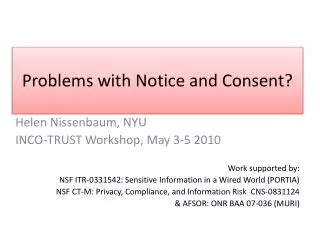
Problems with Notice and Consent? Helen Nissenbaum, NYU INCO-TRUST Workshop, May 3-5 2010 Work supported by: NSF ITR-0331542: Sensitive Information in a Wired World (PORTIA) NSF CT-M: Privacy, Compliance, and Information Risk CNS-0831124 & AFSOR: ONR BAA 07-036 (MURI)
1973: HEW Code of Fair Information Practices 1980: OECD Guidelines 1995: EU Data Directive Principles 1998: FTC Privacy Principles Elements: Transparency, notice, purpose and use specification, choice, access, integrity, security, proportionality, enforcement, redress
Problems Consent: Costly in time and resources Confusing cross-national requirements Opt-in or Opt-out? Soft coercion Notice: Abstruse Yawning loopholes Time-consuming Fickle People don’t read them
Solutions? Better models of control Substantive requirements
Contextual Integrity:Context-relative Informational Norms = Rules within contexts that prescribe the flow of personal information according to three key parameters: Actors (Sender:Recipient:Subject) Information types Transmission principles All parameters must be specified!
CRIN expressed in Linear Temporal Logic From: A. Barth, A. Datta, J. Mitchell, and H. Nissenbaum, (2006) “Privacy and Contextual Integrity: Framework and Applications,” Proceedings of the IEEE Symposium on Security and Privacy.
A customer’s address held by a merchant may be shared with a shipping company andwith no other party.