SlideServe
Menu
Préférences
© SlideServe · v2026

Chapter 20: Carboxylic Acid Derivatives - NAS

major avatar
24 diapositives · 701 Views · Sep 25, 2014

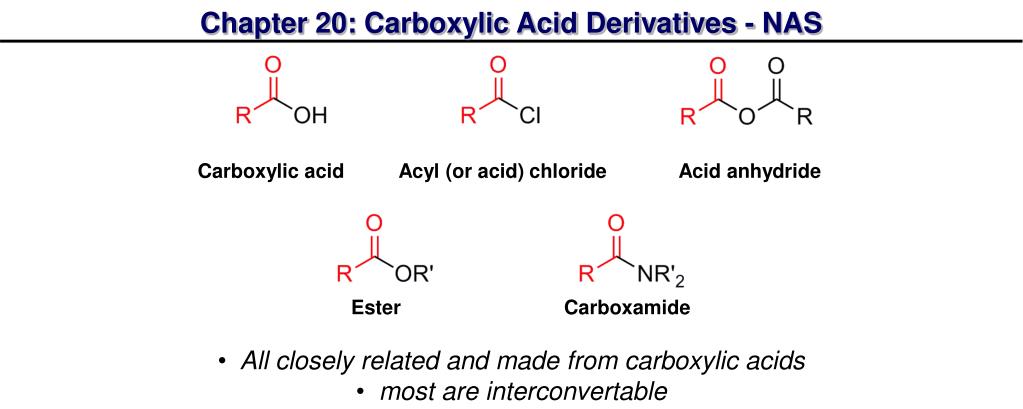
Chapter 20: Carboxylic Acid Derivatives - NAS. Carboxylic acid. Acyl (or acid) chloride. Acid anhydride. Ester. Carboxamide. All closely related and made from carboxylic acids most are interconvertable. 20.1 – Carboxylic Acid Derivative Nomenclature. Acyl Chlorides. Acid Anhydrides.
Chapter 20: Carboxylic Acid Derivatives - NAS - slide 1
01 / 24Chapter 20: Carboxylic Acid Derivatives - NAS
1 / 17

Télécharger la présentation

Chapter 20: Carboxylic Acid Derivatives - NAS
Une image / un lien ci-dessous est fourni (tel quel) pour télécharger la présentation

Politique de téléchargement : le contenu du site vous est fourni TEL QUEL pour votre information et votre usage personnel ; il ne peut être vendu, concédé sous licence ni partagé sur d’autres sites sans l’accord de son auteur.Le contenu vous est fourni TEL QUEL, pour votre information et votre usage personnel uniquement. Téléchargez la présentation en cliquant sur ce lien. Lors du téléchargement, si vous ne parvenez pas à télécharger une présentation, l’éditeur a peut-être supprimé le fichier de son serveur.Pendant le téléchargement, si vous ne parvenez pas à obtenir une présentation, le fichier a peut-être été supprimé par l’éditeur.

F I N

Plus de contenu associé

Transcription de la présentation
  1. Chapter 20: Carboxylic Acid Derivatives - NAS Carboxylic acid Acyl (or acid) chloride Acid anhydride Ester Carboxamide • All closely related and made from carboxylic acids • most are interconvertable

  2. 20.1 – Carboxylic Acid Derivative Nomenclature Acyl Chlorides Acid Anhydrides

  3. 20.2 – Carboxylic Acid Derivatives - Structure Extended  system – like carboxylic acids

  4. 20.2 – Structure and Reactivity Fig. 20.2

  5. 20.2 – Structure and Reactivity Resonance possibilities - acid chlorides and anhydrides Acid chlorides and acid anhydrides are not stabilized significantly by resonance – quite reactive towards nucleophiles

  6. 20.2 – Structure and Reactivity Resonance possibilities – esters, amides, carboxylates Increasing delocalization leads to increasing stability and decreasing reactivity

  7. 20.3 – General Mechanism for Nucleophilic Acyl Substitution Tetrahedral intermediate

  8. 20.4 – NAS Using Acid Chlorides

  9. 20.4 – NAS Using Acid Chlorides, e.g. Amide Synthesis Tetrahedral intermediate

  10. 20.5 – Acyl Substitution in Carboxylic Acid Anhydrides Synthesis of anhydrides Acetic anhydride Maleic anhydride

  11. 20.5 – Acyl Substitution in Carboxylic Acid Anhydrides Lab experiment

  12. 20.5 – Acyl Substitution in Carboxylic Acid Anhydrides Lab experiment 3720

  13. 20.5 – Acyl Substitution in Carboxylic Acid Anhydrides 50-75% decrease in S. aureus CP construction Selective inhibitor of endothelial cell proliferation

  14. 20.5 – Acyl Substitution in Carboxylic Acid Anhydrides • “N-Glycoside neoglycotrimers from 2,3,4,6-tetra-O-acetyl-beta-D-glucopyranosyl azide,” D. P. Temelkoff, M. Zeller, and P. Norris, Carbohydr. Res.2006, 341, 1081-1090. • “Application of Bis(diphenylphosphino)ethane in Staudinger-type N-Glycosyl Amide Synthesis,” D. P. Temelkoff, C. R. Smith, D. A. Kibler, S. McKee, S. Duncan, M. Zeller, M. Hunsen, and P. Norris, Carbohydr. Res.2006, 341, 1645-1656.

  15. 20.6 – Sources of Esters

  16. 20.7 – Physical Properties of Esters

  17. 20.10 – Reactions of Esters Acid-catalyzed hydrolysis Basic hydrolysis – saponification

  18. 20.12 – Thioesters Acetyl coenzyme A

  19. 20.13 – Amides Hydrogen bonding

  20. 20.11-13 – Amides – Structure and Synthesis

  21. 20.14 – Intramolecular Amide Formation – Lactams

  22. 20.15 – Hydrolysis of Amides – not covering

  23. 20.16 – 20.17 – Preparation and Hydrolysis of Nitriles • Protonate nitrogen, attack C with water • Proton transfer to nitrogen followed by enolization • Rest of mechanism the same as the amide hydrolysis

  24. 20.18 – Addition of RMgX to Nitriles – Not Covering