Download
1 / 27
270 likes | 389 Vues
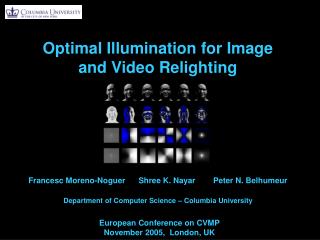
This work presents a novel approach to image-based relighting by optimizing the basis images and reflectance fields. It builds on previous methodologies, including seminal works like The Light Stage and Environment Matting, integrating techniques for accurate relighting of both diffuse and specular materials. The proposed three-step algorithm comprises basis image recording, reflectance field calculation, and the combination of captured reflectance with a light map to achieve photorealistic results. The research highlights practical setups using HDR photography and calibration methods, along with comparisons to stochastic ray tracing, paving the way for future developments in light manipulation technologies.

E N D
Accurate Image Based Relighting through Optimization Pieter Peers Philip Dutré Department of Computer Science K.U.Leuven, Belgium
What is Image Based Relighting? Basis Images Relit Image Processing & Relighting
Previous Work • The Light Stage (Debevec et al. ’00) Images: ACM SIGGRAPH ‘00
Previous Work • Environment Matting (Zonker et al. ’99, Chuang et al. ’00) Images: ACM SIGGRAPH ’99
Previous work Sparse sampling of light source directions Sufficient angular sampling Large span of incominglight directions Bundled incominglight directions • Matusik et al. EGWR’02
Three-step algorithm 2 1 Basis Image Recording Reflectance field calculation 3 Relit image = Captured reflectance + Light-map
... Basis Image Recording HDR photographs
Practical Setup • HDR photographs • Monitor calibration • 4x4 grid, 9 patterns per lightpatch • ±600 basis images
Three-step algorithm 2 1 Basis Image Recording Reflectance field calculation 3 Relit image = Captured reflectance + Light-map
Reflection Coefficient Resulting Value →Error1 = = →Error2 × Rpix,patch … = →Errorn-1 = →Errorn Find and Rpix,patch that minimize: Errork Support and reflectance Patterns Pixel … …
top back left right Support and reflectance: examples click
Three-step algorithm 2 1 Basis Image Recording Reflectance field calculation 3 Relit image = Captured reflectance + Light-map
Re-lighting For each pixel: Pixel value = ∑ Filteri(LightMap) × Rpix,isupport i
Results B A D C
Results B A D C
Results B A D C
Results B A D C
Comparison Relit from rendered basis images Stochastic ray tracing
Comparison Relit from rendered basis images Stochastic ray tracing
Comparison Relit from rendered basis images Stochastic ray tracing
Conclusion • Accurate relighting: • Diffuse materials • Specular materials • Combine strengths from: • The Light Stage • Environment matting
Future Work • Alternative emitting devices • Investigate other patterns & optimization algorithms
Acknowledgements • Frank Suykens and Vincent Masselus • Some environment maps from: http://www.debevec.org/Probes
Thank you… Questions?